Why Airplane Windows Have That Tiny Hole — And 7 Other Design Details You Never Noticed
By WowPebble Editorial
Understand the bleed hole in a conventional multi-pane airplane window, how it affects pressure, and seven other documented everyday design details.
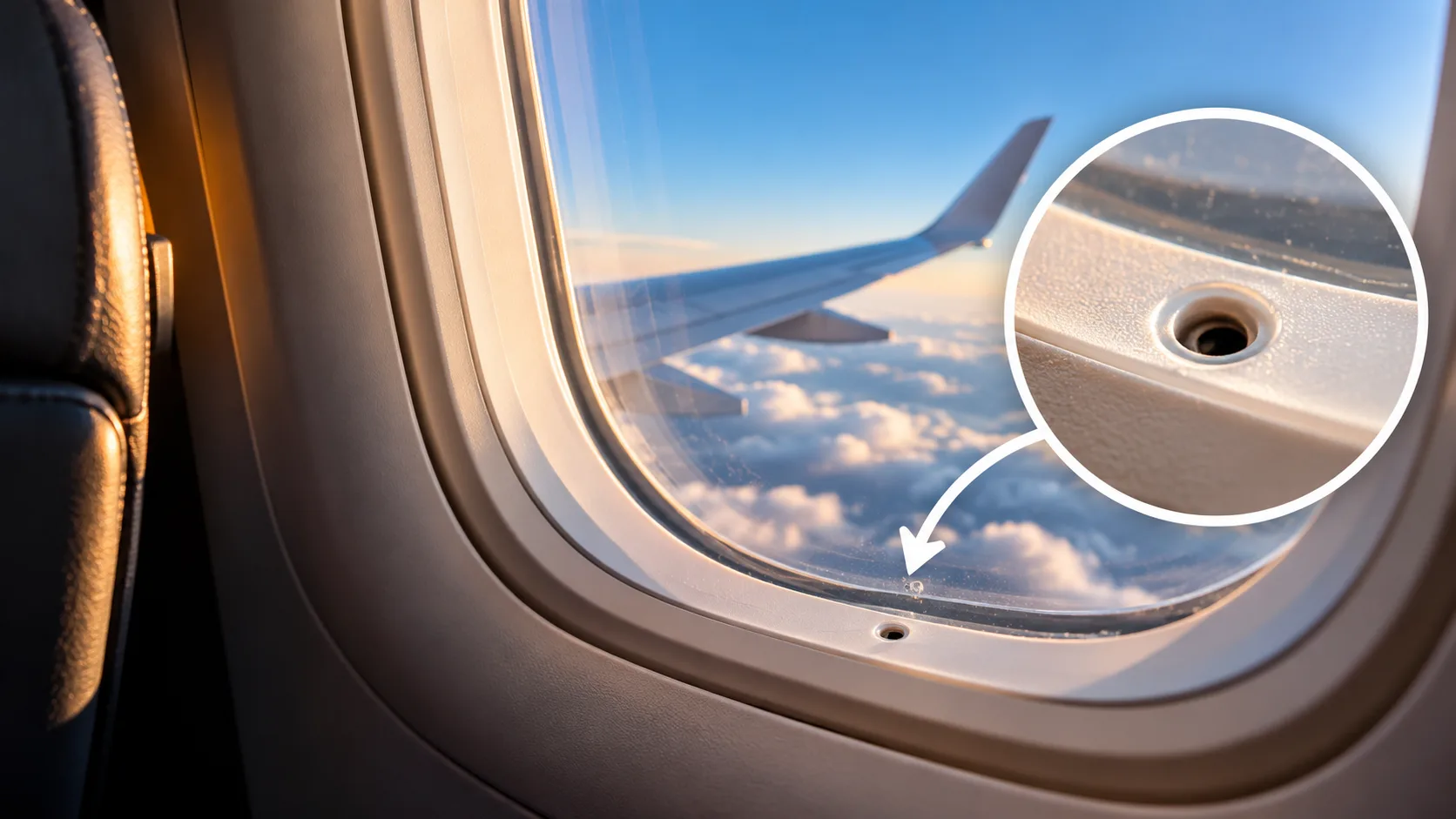
An intentional opening in a conventional vented airliner passenger window is called a breather or bleed hole. In the three-pane arrangement described below, it is in the middle structural pane—not the cabin-side protective pane nearest the passenger. It lets pressure in the space between structural panes follow cabin pressure; it is not a drilled passage through the outer window into the outside air.
That distinction explains the window more accurately than simply calling the hole “ventilation.” Here is the mechanism, followed by seven shorter comparisons with other documented design details.
1. The airplane-window hole: identify the layers first
The AAIB report on Airbus A321-253NX G-OATW, PDF page 5 describes two structural panes and a separate cabin-trim scratch pane. The vent is in the inner structural pane; the scratch pane protects it from passenger contact and is not load-bearing. When all three are counted, that inner structural pane is the middle one. This named example explains why calling a pane simply ‘inner’ can be ambiguous.
For that arrangement, the order from the passenger outward is:
- Cabin-side scratch pane: protection from passenger contact.
- Middle structural pane: includes the small ventilation opening.
- Outer structural pane: separates the window assembly from outside air.
In its description of a conventional assembly, the earlier Boeing structural-window description explains the load path: the breather hole communicates with the cavity, allowing the outer pane to carry the normal pressure load rather than sealing that load against the inner structural pane. This explains why a tiny opening can be intentional without being a cabin leak to the sky. Actual designs vary: the description is not a parts diagram for every aircraft or cockpit window.
Does it always prevent fogging?
No. Boeing's window-airflow patent describes a reason to control airflow through the vent: vibration can move moist cabin air into the cavity and contribute to fogging. So “the hole lets moisture escape and prevents fogging” is too simple as a general explanation. The dependable point here is pressure communication; moisture behavior depends on the assembly and conditions.
This is an explanation of design, not a way for passengers to certify a window's condition. Do not block or probe an opening. Show an unfamiliar crack or mark to cabin crew rather than deciding that anything resembling a bleed hole must be harmless. The separate question of window shape is covered in why airplane windows have rounded corners.
2. A pen-cap hole is not the barrel's pressure vent
BIC's Cristal diagram, PDF page 6 links its cap hole to a safety standard and gives the separate barrel hole a pressure-balancing role. An opening in the cap should not be explained by copying the barrel's function. Vented caps are not a guarantee against choking; see the comparison of everyday openings for the safety distinction.
3. Extra shoe eyelets can support a runner's loop
ASICS demonstrates a lacing arrangement in which loops formed at upper eyelets receive the opposite laces. It is a documented use of that eyelet arrangement, not proof that all spare holes are intended for it. The relevant clue is the path of the laces, rather than the opening alone.
4. A fuel-gauge arrow points to the filler side
A Ford manual identifies the arrow beside the pump symbol as the filler-door side indicator. Do not infer the side from an unrelated part of the pump illustration. The dedicated fuel-arrow guide explains how to interpret the cue in an unfamiliar car.
5. Some spaghetti servers include a portion guide
Zyliss describes the central opening on its server as a measuring guide. This supports a specific product feature; it does not turn the hole in every pasta spoon into the same portion. A visual resemblance is not a stated serving weight.
6. A mug-base groove can have a documented drainage purpose
IKEA identifies drainage gates on its FÄRGRIK mug as paths for water that would otherwise collect when the mug is upside down in a dishwasher. The product identification matters: it does not establish that an irregular chip in an unknown mug was deliberately designed.
7. The F and J bumps are touch-typing landmarks
HP's typing guide explains that raised marks on F and J help users locate the home row without looking. Unlike a window vent or a drain, their purpose is to be felt, not to let something pass through.
8. The jeans pocket has a specific historical example
Levi Strauss & Co. identifies its small front pocket as a watch pocket. That archival account supports the history of Levi's design, rather than an assumption about every maker. Our jeans-pocket explanation treats that question separately.
You might also like

Why Airplane Windows Are Round Instead of Square
Rounded airplane windows are more than a design choice: their smooth corners help limit the stress that repeated cabin pressurization puts on an aircraft.

Why Some Everyday Objects Have Strange Little Holes
Learn how pen vents, plant-pot drains, window openings and SIM-tray holes work, with documented examples and clear limits for different products.

Why Do Mirrors Reverse Left and Right but Not Up and Down?
A mirror does not actually swap left and right. It reverses the direction pointing into the glass—and the way we compare ourselves with the reflection creates the illusion.