Why Do Mirrors Reverse Left and Right but Not Up and Down?
By WowPebble Editorial
A mirror does not actually swap left and right. It reverses the direction pointing into the glass—and the way we compare ourselves with the reflection creates the illusion.
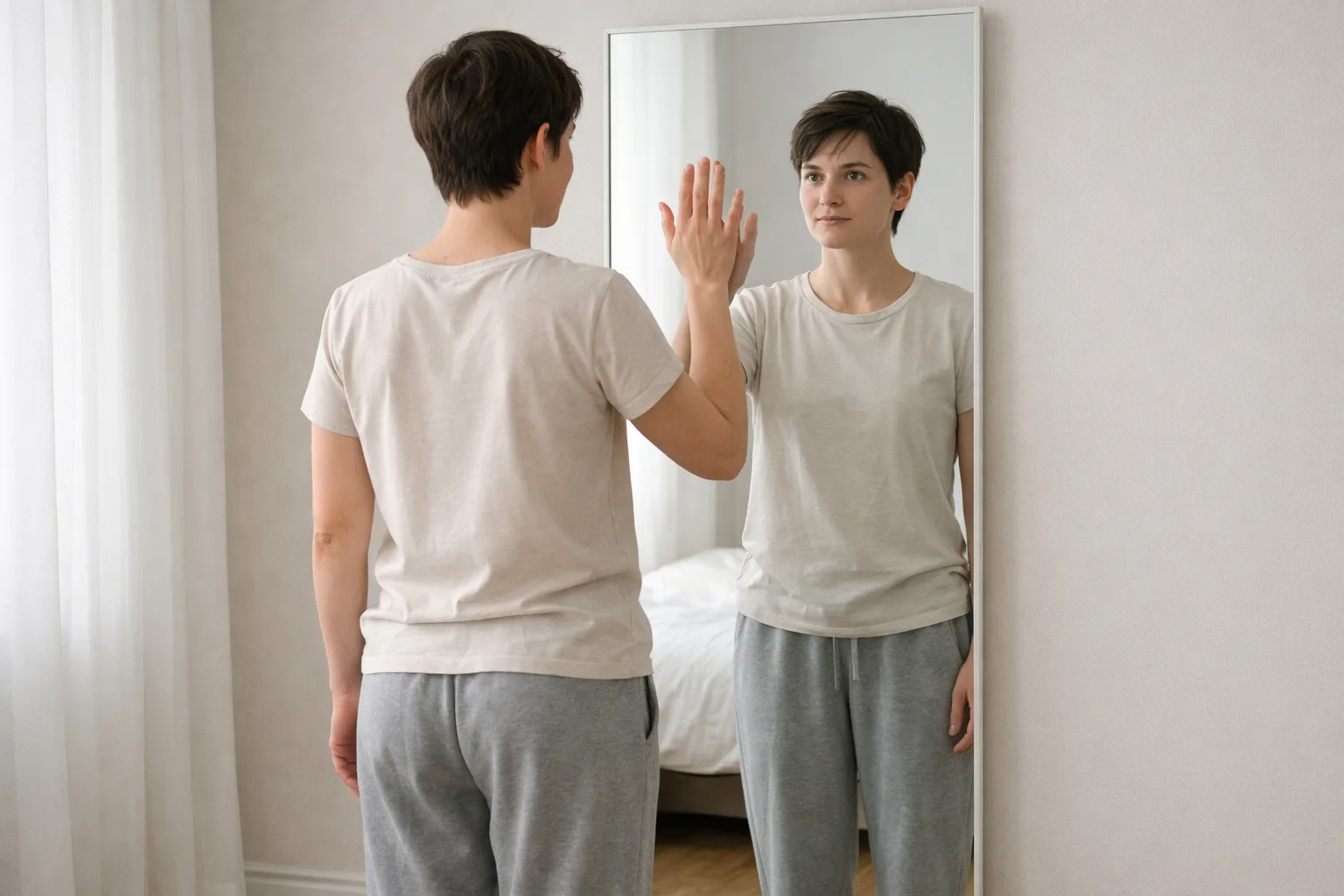
A mirror doesn’t actually swap left and right. It reverses front and back: the direction pointing toward the glass is reflected back toward you. Because we imagine turning to face our reflection, that front-to-back reversal can seem like a left-right swap. Up and down stay put because they run parallel to the mirror’s surface.
What the mirror actually changes
Imagine three directions: up and down, left and right, and toward and away from the mirror. A flat mirror reverses only the third. It reflects light from you back to your eyes, preserving the vertical and horizontal directions across the mirror’s surface.
That’s why the reflection of a raised hand is still raised, and your head remains above your feet. The mirror hasn’t turned the scene upside down or exchanged its left and right sides. It has reversed the direction perpendicular to its surface.
Why it looks like a left-right swap
The trick is how we compare the reflection with ourselves. You and your image face one another. To imagine your reflection standing beside you and facing the same way, you picture it turning around—usually by rotating it about a vertical axis. That imagined turn swaps left and right, making the reflection seem reversed.
Try raising your right hand while facing a mirror. The reflection’s corresponding hand appears on the left side from your viewpoint. But it is the image of your right hand, not a left hand transformed into a right one. The apparent swap comes from comparing two people who face each other, not from the mirror exchanging their sides.
A useful way to picture it
Imagine a word written on a transparent sheet. Hold it up so you can read it, then turn it around to face someone on the other side. The letters now look backward to you. The turn has reversed the sheet’s front and back, and that change affects how you see the writing. A mirror similarly reverses depth; it doesn’t selectively flip letters or swap the left and right edges of the scene.
This is also why a mirror reverses writing but not height. The writing faces the mirror, so its front-to-back orientation is reflected. Its top stays at the top because the mirror does not reverse the vertical direction.
So the short answer is: mirrors reverse front and back, not left and right. The apparent left-right reversal is a result of how we imagine turning to face our reflection, while up and down remain unchanged because they lie along the mirror’s surface.
You might also like
Why Does a Retractable Pen Click When You Press It?
A retractable pen’s click comes from a small locking mechanism inside its barrel. Here’s how the button, cam and spring work together to extend and retract the tip.
Why Do Chimneys Have Caps? The Practical Reasons Explained
Chimney caps keep out rain, animals and debris, and some help contain sparks or reduce wind-driven downdrafts. Here’s how they work—and what they don’t do.
Why Do Eyeglasses Have Nose Pads?
Nose pads help glasses sit securely and comfortably by supporting the frame on the nose. Their position can also be adjusted to improve fit and lens alignment.