Why Do Stars Twinkle More Than Planets?
By WowPebble Editorial
Stars look like they flicker while planets usually shine steadily. The difference comes down to their apparent size and the moving layers of Earth’s atmosphere.
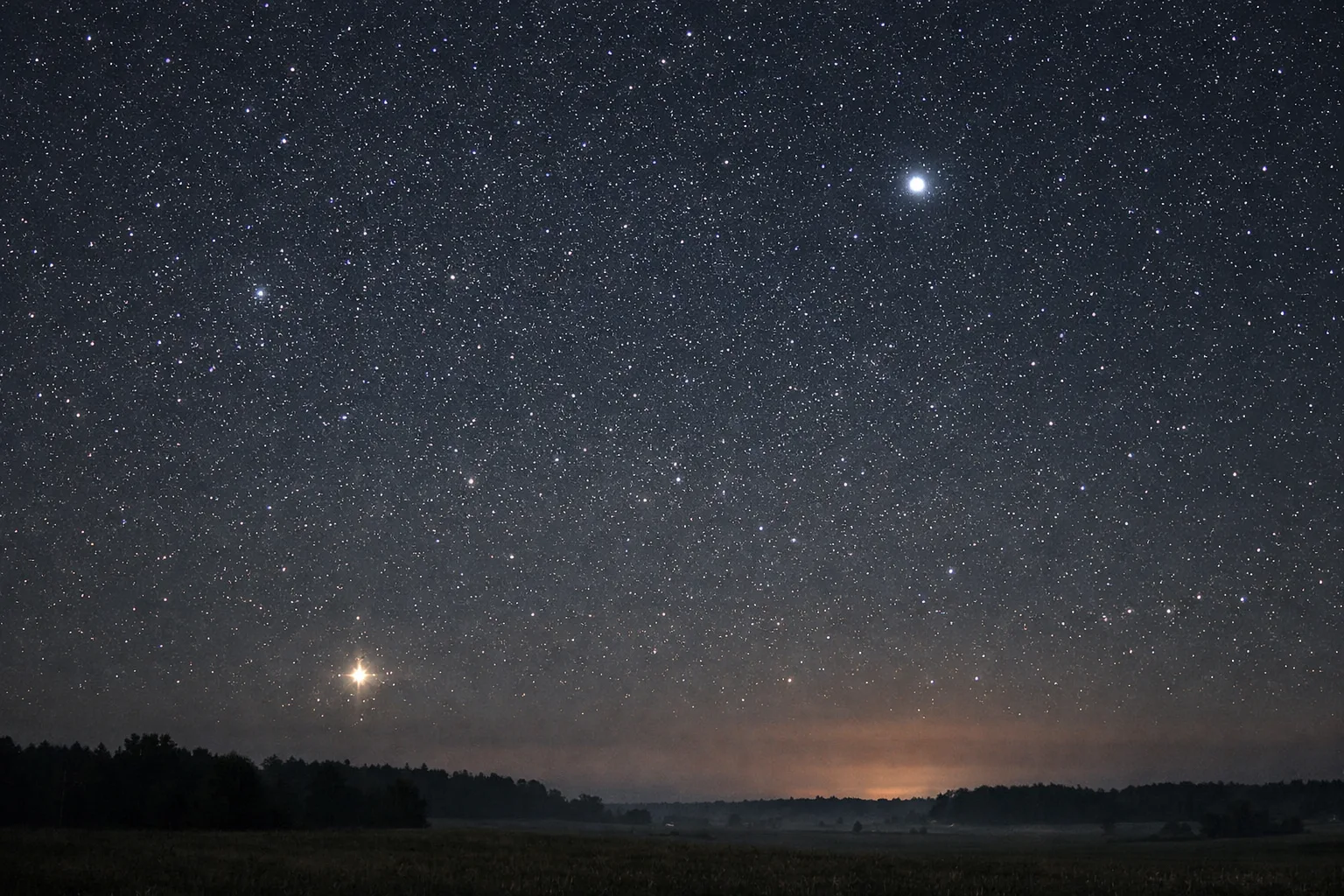
On a clear night, stars may shimmer and flash, while a bright planet nearby seems to hold a steadier glow. The main reason is not that stars are more changeable: it is that they appear as tiny points of light, while planets show a small but measurable disk. Earth’s restless atmosphere can make light from a point source fluctuate more noticeably than light arriving from a wider source.
The atmosphere bends starlight
Light from a star travels a vast distance through space before reaching Earth. By the time it arrives, the star is so far away that even a powerful telescope sees it as a point of light rather than a visible disk. This is true of the stars we see with the naked eye, too.
But the last stretch of that journey passes through Earth’s atmosphere. The air is not perfectly still or uniform. Pockets of air differ in temperature and density, and those differences affect how light travels through them. As moving layers of air pass across the line of sight, they bend incoming starlight by slightly changing its path.
The result is a rapid apparent shift in a star’s position and brightness. This effect is called scintillation, or, more commonly, twinkling. The star itself is not switching on and off. Its light is being disturbed on its way to your eyes.
Why a planet’s light is steadier
Planets are much closer to Earth than stars, so they appear larger in the sky. They are still tiny to the unaided eye, but they are not perfect points: each has a small apparent disk made up of light coming from slightly different directions.
Atmospheric turbulence can disturb light from one part of that disk while affecting light from another part differently. When the separate fluctuations blend together in your view, they tend to average out. That makes the planet’s overall brightness and position seem steadier than a star’s.
Think of the difference as watching a single candle flame through rippling air versus watching a small cluster of flames. Disturbances may affect each one differently, so their combined glow varies less. The comparison is only an illustration, but it captures the basic idea: light spread across an apparent disk is less vulnerable to the same noticeable flicker as light concentrated in a point.
Planets do not have to be perfectly steady. They can twinkle, especially when they are low in the sky or when the atmosphere is turbulent. The contrast is usually a matter of degree: stars tend to show more obvious twinkling, not an entirely different kind of light.
Why stars can flash different colors
The atmosphere can also make a bright star appear to change color briefly. Different wavelengths of light are bent by slightly different amounts as they pass through air. When turbulence shifts the light reaching your eye, flashes of color can become noticeable.
This is often easiest to spot when a bright star is close to the horizon. It may seem to flicker red, blue, or white, even though it is not rapidly changing its actual color. The color effect is atmospheric, just like the twinkling.
The horizon makes twinkling stronger
A star near the horizon usually twinkles more than the same star when it is high overhead. Its light must travel through a longer path in Earth’s atmosphere to reach you, giving it more chances to encounter layers of moving air.
That longer path can also make celestial objects look dimmer and less sharp. For a practical test, compare a bright star low in the sky with another much higher up. The lower one will often appear to shimmer more. The atmosphere on a particular night matters, too: shifting air can make the view unsteady even when the sky looks clear.
Can twinkling help identify a planet?
It can offer a clue. If a bright object shines with a relatively steady light while nearby stars seem to flicker, the object may be a planet. But steadiness alone is not a sure way to identify it. A planet low above the horizon may twinkle, and a star high in a calm sky may look quite steady.
A sky map or astronomy app can help confirm what you are seeing. Planets also change position against the background stars over time, which is why their name comes from an ancient Greek word meaning wanderer. Their movement is gradual, though; watching for a few minutes is more useful for noticing atmospheric twinkling than planetary motion.
What twinkling tells astronomers
For casual skywatching, twinkling adds sparkle. For astronomers, the same atmospheric motion can blur and distort observations. Ground-based observatories often choose high, dry locations where conditions are more favorable, and some telescopes use adaptive optics: systems that measure atmospheric distortion and adjust a mirror to compensate for it.
Astronomers also describe the steadiness of the atmosphere as seeing. Good seeing means stars look relatively sharp through a telescope; poor seeing makes them appear to dance or blur. It is not the same as whether the sky is cloudy or dark. A clear night can still have turbulent air.
The short answer
Stars twinkle more than planets because they appear as point sources, so changing atmospheric conditions can make their light fluctuate noticeably. Planets appear as small disks, and the variations across those disks tend to average out. Earth’s atmosphere creates the shimmer; the difference in apparent size helps determine how much of it you see.
You might also like

How Do Mushrooms Seem to Appear Overnight?
Mushrooms don’t grow from nothing in a single night. Their hidden fungal network can produce visible fruiting bodies quickly when conditions are right.

How Tidal Bores Send Waves Upstream
A tidal bore forms when a rising tide is funneled into a shallow river mouth, steepening into a moving front that can surge against the river’s flow.

Why Chameleons Change Color—and What the Colors Signal
Chameleons change color to communicate, respond to temperature and light, and sometimes blend in. Their shifting shades come from both pigments and remarkable skin cells.