Why the Moon’s Far Side Looks So Different from Its Near Side
By WowPebble Editorial
The Moon’s far side is more rugged and cratered, with far fewer dark plains. Its thicker crust and different volcanic history help explain the striking contrast.
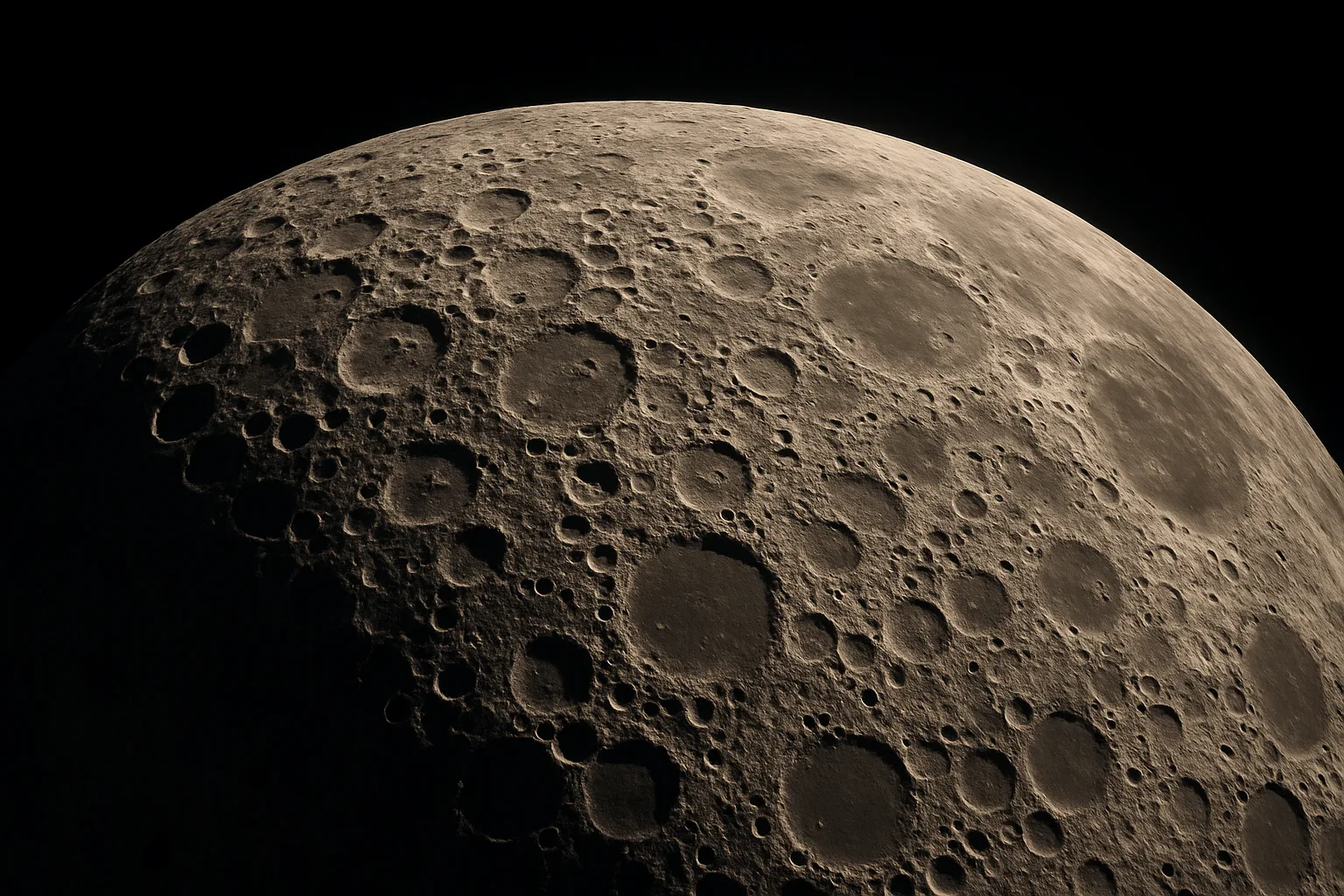
From Earth, the Moon looks familiar: a bright, cratered world marked by broad dark patches. Turn it around, though, and the view changes. The far side is much more rugged, with many craters and fewer of the dark plains that give the near side its familiar face.
The main reason is that the two hemispheres have different surfaces and geological histories. The near side has more of the broad, low-lying basins that ancient lava flooded. The far side has a thicker crust in many areas, which made it harder for lava to reach the surface. Scientists have several ideas about why this difference developed, but there is no single, fully settled explanation.
The far side is not the dark side
The Moon rotates, but it takes almost exactly as long to spin once on its axis as it takes to orbit Earth. This synchronized motion, called tidal locking, means the same hemisphere generally faces us. The hemisphere turned away is known as the far side.
It is not permanently dark. As the Moon orbits Earth, sunlight falls on different parts of its surface. The far side has lunar days and nights just like the near side. We can also glimpse a little beyond the usual edge because the Moon’s orientation wobbles slightly as it moves along its orbit. Over time, this effect lets observers see about 59 percent of the lunar surface, though never the entire far side at once.
The distinction is about what we can see from Earth, not about light. The far side receives sunlight, and it has been photographed and mapped by spacecraft.
Dark plains and rugged highlands
The dark patches on the near side are called lunar maria, the Latin word for seas. They are not bodies of water. They are vast plains of basalt, a dark volcanic rock, formed when molten material spilled across the Moon’s surface billions of years ago and later cooled.
Many maria occupy enormous impact basins. Early in lunar history, large objects struck the Moon and left deep scars. Later, basaltic lava rose from below and filled some of these low areas, leaving relatively smooth plains. The maria are much more extensive on the near side; the far side has only scattered volcanic plains.
Instead, much of the far side is made up of bright, ancient highlands. These areas are densely pocked with impact craters, including craters that overlap one another. That crowded appearance records a long history of impacts, with fewer later lava flows to smooth or cover the older terrain.
The far side is not completely without volcanic plains, and it is not simply a uniform field of craters. It includes huge impact structures, varied elevations, and regions with distinct geological histories. But the contrast with the near side is unmistakable.
A thicker crust may have blocked the lava
The far side's thicker crust is a likely explanation discussed by NASA for its smaller extent of dark maria: it can make it harder for molten material to reach the surface. Treat the measured asymmetry and a proposed explanation of volcanic history as different kinds of evidence, not as a complete proof of how the two sides formed.
That helps explain why the far side has fewer maria, but it does not explain by itself why the Moon developed such different crusts. The difference is known as the lunar near-side–far-side dichotomy, and researchers are still working out how it arose.
A NASA/JPL account of GRAIL gravity research gives another clue: the near side appears to have a warmer mantle region, interpreted as evidence for heat-generating radioactive elements. This connects composition and heat with the history of volcanism. It is a model-based interpretation, not proof that one ingredient alone explains every volcanic plain.
That is a plausible part of the story, not a complete answer. The Moon’s early formation, the way its crust and interior cooled, and differences in the distribution of materials may all have contributed. Scientists continue to test how these factors fit together.
Why did the two sides develop differently?
NASA’s composition overview describes the young Moon cooling from a molten state, with denser material sinking and lighter material rising toward the crust. That broad differentiation picture does not, by itself, explain why the crust ended up thicker on one hemisphere.
But the Moon did not end up with identical geology on both sides. Its near side faces Earth, and its far side faces away. Researchers have explored whether conditions during the Moon’s early evolution—including its relationship with Earth—could have influenced how heat and materials were distributed. The details remain an active scientific question: no one explanation yet accounts for every feature of the divide.
Impact history adds another layer. The far side includes the South Pole–Aitken basin, one of the largest and oldest known impact structures on the Moon. Its enormous size shows that the far side was not spared major impacts. What differs is how those impacts interacted with the crust and whether later lava reached the basins they left behind.
How spacecraft revealed the hidden hemisphere
For centuries, people could study only the side of the Moon visible from Earth. That changed in 1959, when the Soviet spacecraft Luna 3 sent back the first photographs of the far side. The images were a milestone, even though they were grainy by modern standards. Later orbiters mapped the region in far greater detail, revealing its craters, basins, and rugged highlands.
The first views also showed why the Moon’s far side could not simply be guessed from the familiar face. It has much less extensive dark maria than the near side, rather than no volcanic terrain at all. Space missions since then have made it possible to study both hemispheres and compare their surfaces and composition.
The far side’s position behind the Moon, out of Earth’s direct line of sight, also makes it useful for some kinds of radio astronomy. The Moon can block radio signals from Earth, creating a quieter observational environment in certain frequency ranges. That does not mean the entire far side is always shielded from every signal, but its location offers a distinctive setting for future instruments.
One Moon, two geological stories
The Moon’s familiar face and its rugged far side are not separate worlds. They are two expressions of the same body, shaped by ancient impacts, volcanic activity, and differences in crust and composition. The near side’s dark plains make its surface look smoother; the far side preserves more of the battered highlands beneath.
We see only one side from Earth because of the Moon’s steady, synchronized rotation. We see two very different landscapes because the Moon’s history was not the same everywhere. The contrast is still helping scientists investigate how our nearest celestial neighbor formed and changed.
You might also like

How Do Mushrooms Seem to Appear Overnight?
Mushrooms don’t grow from nothing in a single night. Their hidden fungal network can produce visible fruiting bodies quickly when conditions are right.
How Tidal Bores Send Waves Upstream
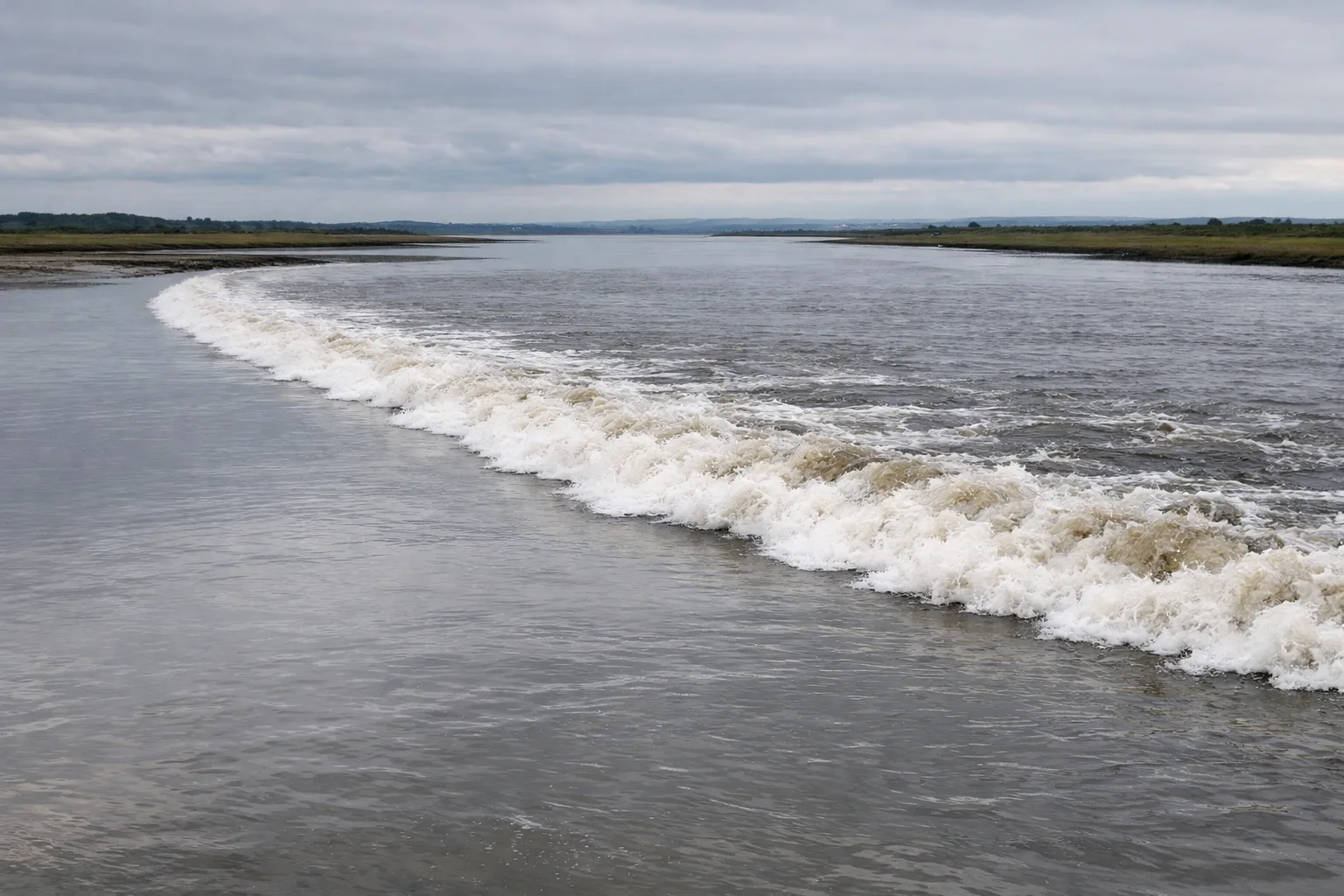
A tidal bore forms when a rising tide is funneled into a shallow river mouth, steepening into a moving front that can surge against the river’s flow.

Why Chameleons Change Color—and What the Colors Signal
Chameleons change color to communicate, respond to temperature and light, and sometimes blend in. Their shifting shades come from both pigments and remarkable skin cells.