Why Are Manhole Covers Round? The Clever Logic Beneath the Street
By WowPebble Editorial
Round manhole covers are more than a familiar street detail. Their shape helps keep them from dropping through openings and makes them easier to handle.
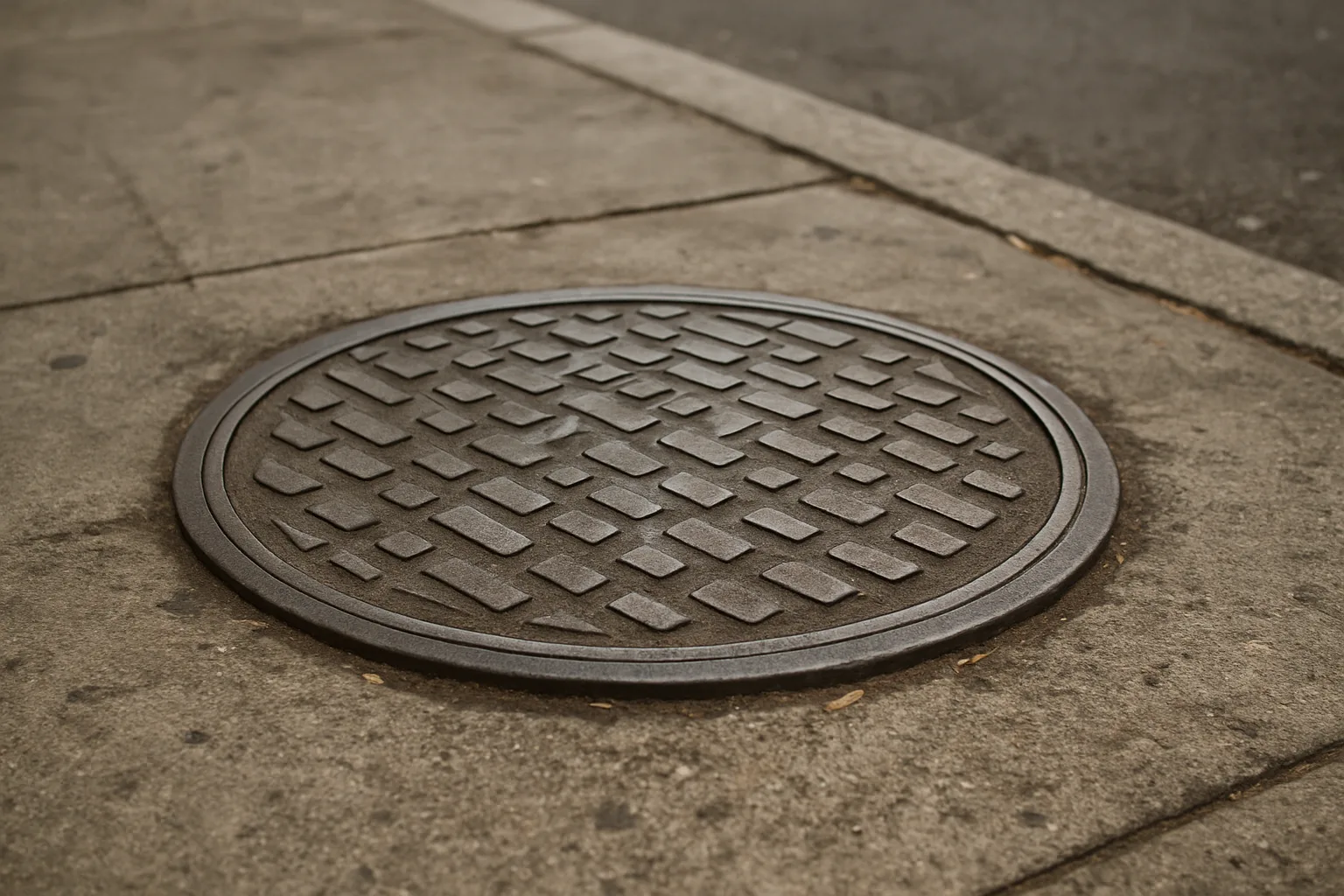
A round manhole cover may look like a simple piece of street hardware, but its shape solves several practical problems at once. Most importantly, a properly sized circular cover cannot drop straight through its matching circular opening: its width stays the same no matter how it is turned. A round cover also needs no alignment, can be rolled into position, and suits many underground access shafts.
That does not mean every utility cover is round, or that circles are the only shape that can work. But for a cover that may be lifted, moved and replaced by workers, the circle is an especially useful design.
The shape that cannot be turned the wrong way
Imagine a circular lid resting over a circular hole. The lid has the same diameter in every direction, so rotating it does not make it narrower. If it is correctly sized to rest on the rim, it cannot slip through the opening simply because someone turns it.
This is the key safety advantage often summed up by saying that a round manhole cover cannot fall in. The wording needs a small qualification: the cover and opening must be designed to fit, and the cover must be seated properly. A damaged, undersized or misplaced cover can still create a hazard. But unlike many shapes, a circle has no orientation in which its span suddenly becomes smaller.
With a cover that has corners, the fit can depend more on its position. Depending on the design, a rectangular or square cover may be easier to tilt, turn or misalign in a way that lets it enter the opening. That is not inevitable for every non-circular cover: a well-designed square cover can also be made secure. The circle simply makes the no-wrong-way-around feature straightforward.
No corners to line up
A circular cover can be set back into place without matching up corners or edges. That is helpful for equipment workers may need to open and close during inspections, repairs or maintenance. After the work is done, the cover can be lowered into its frame in any rotational position.
The benefit is modest each time, but practical over the life of a busy street. Covers are heavy, and workers may need to handle them in awkward conditions. A shape that does not require precise alignment makes replacing one simpler and helps reduce the chance of a poor fit.
Rolling can be easier than lifting
Many manhole covers are heavy enough that moving them entirely by hand is difficult. A circular cover can be tilted onto its edge and rolled or guided along the ground, rather than carried flat. This does not make it light, and safe handling still matters, but it gives workers another way to move it.
A round cover also has no protruding corners to catch as it is rolled. By contrast, a cover with corners may need to be lifted or manoeuvred more carefully around its frame. In practice, the method used depends on the cover’s weight, equipment and working conditions.
A natural match for underground access
Manholes provide access to underground infrastructure, including sewer systems and other utility networks. Many access shafts are circular, and a circular opening is a natural match for a circular cover. The shape also avoids sharp corners in the cover itself, which can be vulnerable to knocks and may concentrate stress.
Still, shape alone does not determine how much weight a cover can safely bear. That depends on factors such as its material, thickness, frame and the support beneath it. A round cover is not automatically stronger than a square one; the whole assembly has to be designed for its setting, including whether it will be exposed to traffic.
Covers and frames are made from different materials, chosen for their strength, weight, durability and location. Metal is common, but other materials are used too. Whatever the material, the cover must fit its frame and withstand the conditions around it.
Why are some utility covers square?
Look around a city and you may spot covers that are square, rectangular or another shape. Not every underground access point is a circular manhole. Some cover shallow service boxes, trenches or chambers whose layout is better suited to straight sides. A rectangular opening can also make it easier to reach equipment arranged along a particular direction.
A cover’s shape can reflect the structure below it, the space available at street level, and the needs of the utility or maintenance crew. Designers can also use features such as a supporting ledge, hinges or locking mechanisms to keep a non-round cover secure. The circular form is common because it combines useful handling and fitting properties, not because other shapes are impossible.
A small design choice with a lasting purpose
Manhole covers rarely attract attention unless one is loose, damaged or being lifted for repairs. Yet their shape reflects the everyday demands of street infrastructure: a cover has to stay in place, be accessible when needed and be manageable for workers.
The circle helps with all three. It has no orientation to get wrong, keeps the same width when turned, and can be rolled rather than carried. Those are simple advantages, but they matter for an object that may be handled repeatedly over many years. The next time you pass a round cover in the pavement, you are looking at a design shaped as much by practical safety and maintenance as by appearance.
You might also like

Why Some Everyday Objects Have Strange Little Holes
Learn how pen vents, plant-pot drains, window openings and SIM-tray holes work, with documented examples and clear limits for different products.

Why Do Bricks Have Holes Through the Middle?
Those holes in bricks are no accident. They help make bricks lighter and more efficient to produce, and can serve practical purposes once the wall is built.

Why Do Mirrors Reverse Left and Right but Not Up and Down?
A mirror does not actually swap left and right. It reverses the direction pointing into the glass—and the way we compare ourselves with the reflection creates the illusion.