Why Earth Has Seasons Despite Its Nearly Circular Orbit
By WowPebble Editorial
Earth’s orbit barely changes its distance from the Sun over the year. The real cause of the seasons is the tilt of our planet’s axis—and the way it changes sunlight.
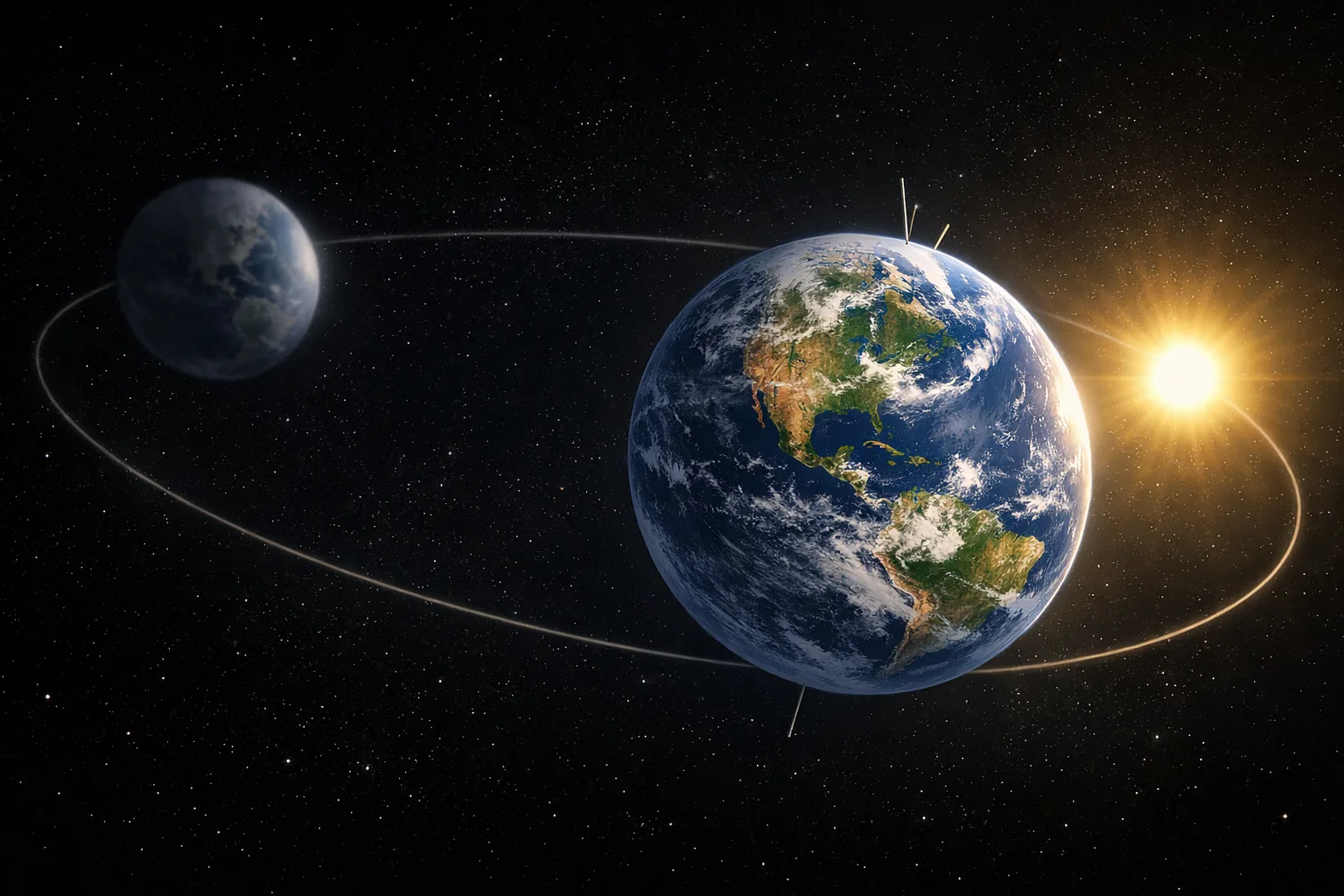
Earth’s orbit around the Sun is almost a circle, so it seems reasonable to expect our distance from the Sun to stay nearly constant—and perhaps wonder how that can produce such different seasons. The key is not how far Earth travels from the Sun, but how its tilted surface receives sunlight as it moves around its orbit.
Earth's rotation axis is tilted about 23.4 degrees from the perpendicular to its orbital plane—not 23.4 degrees directly from the plane itself. NASA describes this as a tilt off vertical. As Earth travels around the Sun, the tilt changes the direction and duration of sunlight received by each hemisphere.
A tilted planet, not a dramatically changing orbit
NASA’s explanation of the seasons distinguishes axial tilt from Earth–Sun distance. Earth’s orbit is slightly elliptical: it is nearest the Sun in early January and farthest away in early July. This distance change affects incoming sunlight, but cannot account for the hemispheres having opposite seasons.
If distance were the main cause of the seasons, the whole planet would have summer when Earth was nearest the Sun and winter when it was farthest away. But the Northern Hemisphere has winter around January, when Earth is closest to the Sun, while the Southern Hemisphere is experiencing summer. Six months later, the situation is reversed: Earth is farther away, yet the Northern Hemisphere has summer and the Southern Hemisphere has winter.
That opposite timing is an important clue. A change in distance affects the whole planet at once; it cannot explain why the hemispheres have opposite seasons. Earth’s tilt can.
How the tilt changes sunlight
As Earth orbits the Sun, its axis keeps pointing in roughly the same direction over the course of a year. For part of the orbit, the Northern Hemisphere leans toward the Sun. About half a year later, it leans away. The Southern Hemisphere experiences the opposite pattern.
When a hemisphere tilts toward the Sun, sunlight strikes the ground more directly. The Sun also follows a higher path across the sky, and daylight lasts longer. More direct rays concentrate their energy over a smaller area, while longer days give the surface more time to receive sunlight. Together, these effects tend to warm the hemisphere.
When a hemisphere tilts away, the Sun appears lower in the sky and its rays arrive at a slant. The same incoming energy is spread across a larger area, and shorter days mean less time in sunlight. The result is less heating and colder conditions.
The contrast is especially striking near the poles. In summer, a polar region can have sunlight for a full day or even for many weeks. In winter, the Sun may not rise for an extended period. Near the equator, day length changes much less through the year, so seasonal temperature swings are often less pronounced, though other local factors still matter.
Solstices and equinoxes mark the cycle
The seasons follow a repeating pattern. A hemisphere’s summer solstice occurs when it is tilted most toward the Sun, bringing its longest day of the year. Its winter solstice comes when it is tilted most away, bringing its shortest day. The solstices occur at opposite times for the Northern and Southern Hemispheres.
Between the solstices are the equinoxes, when the Sun’s centre crosses the celestial equator. Day and night are close to equal, rather than exactly equal everywhere. The US Naval Observatory explains why: sunrise and sunset use the edge of the solar disk, and atmospheric refraction makes the Sun appear above its geometric position. The date of equal observed day and night also depends on latitude.
These astronomical markers describe the relationship between Earth’s tilt and the Sun. They do not mean that the hottest or coldest weather must happen on the solstice. Land and water take time to heat up and cool down, so the warmest and coldest periods often arrive later. Local weather patterns also influence when a place feels most like summer or winter.
Why the seasons are not equally severe everywhere
The tilt sets the broad seasonal pattern, but it does not determine every region’s climate on its own. Oceans warm and cool more slowly than land, helping moderate temperatures near coasts. Inland areas can experience larger swings. Mountains, prevailing winds, ocean currents, cloud cover, and the distribution of land and sea all shape local conditions.
The strength of the seasons also varies by latitude. At high latitudes, the yearly changes in daylight are large. Near the equator, daylight remains fairly steady, though rainy and dry seasons may be more noticeable than hot and cold ones. A place’s seasonal experience depends on more than its position in one hemisphere.
People also use different definitions of when a season begins. Astronomical seasons are tied to solstices and equinoxes. Meteorological seasons divide the year into three-month periods based on the calendar, which can be more convenient for comparing weather records. Neither convention changes the underlying cause: the changing distribution of sunlight over the year.
What Earth’s distance does—and does not—do
Earth’s changing distance from the Sun is not irrelevant. Because sunlight becomes weaker with distance, the planet receives somewhat more solar energy when it is nearer the Sun than when it is farther away. But that modest global variation does not create the opposing seasonal pattern in the two hemispheres.
Instead, the distance effect slightly modifies the seasons that the tilt creates. For example, the Southern Hemisphere’s summer occurs near Earth’s closest approach to the Sun, while its winter falls near the farthest point. The Northern Hemisphere has the reverse timing. How strongly that difference affects temperatures depends on the broader climate system, including the amount of land and ocean in each hemisphere.
A simple way to picture it
Imagine a lamp shining on a tilted globe. As you move the globe around the lamp while keeping its axis tilted in the same direction, first one hemisphere leans toward the light and then the other. The side tilted toward the lamp gets more direct light and longer illumination; the side tilted away gets less. The lamp’s distance matters a little, but the changing angle and duration of the light explain the main seasonal pattern.
That is why a nearly circular orbit is no obstacle to having seasons. Earth does not need to travel dramatically closer to and farther from the Sun. Its steady tilt is enough to change where sunlight falls most directly and how long each part of the planet receives it—producing the familiar yearly cycle of summer and winter.
You might also like

How Satellites Stay in Orbit Without Falling to Earth
Satellites are falling toward Earth all the time—but their sideways speed keeps them missing the ground. Here’s how gravity, velocity and orbital adjustments work together.

How Do Mushrooms Seem to Appear Overnight?
Mushrooms don’t grow from nothing in a single night. Their hidden fungal network can produce visible fruiting bodies quickly when conditions are right.

How Tidal Bores Send Waves Upstream
A tidal bore forms when a rising tide is funneled into a shallow river mouth, steepening into a moving front that can surge against the river’s flow.