How Satellites Stay in Orbit Without Falling to Earth
By WowPebble Editorial
Satellites are falling toward Earth all the time—but their sideways speed keeps them missing the ground. Here’s how gravity, velocity and orbital adjustments work together.
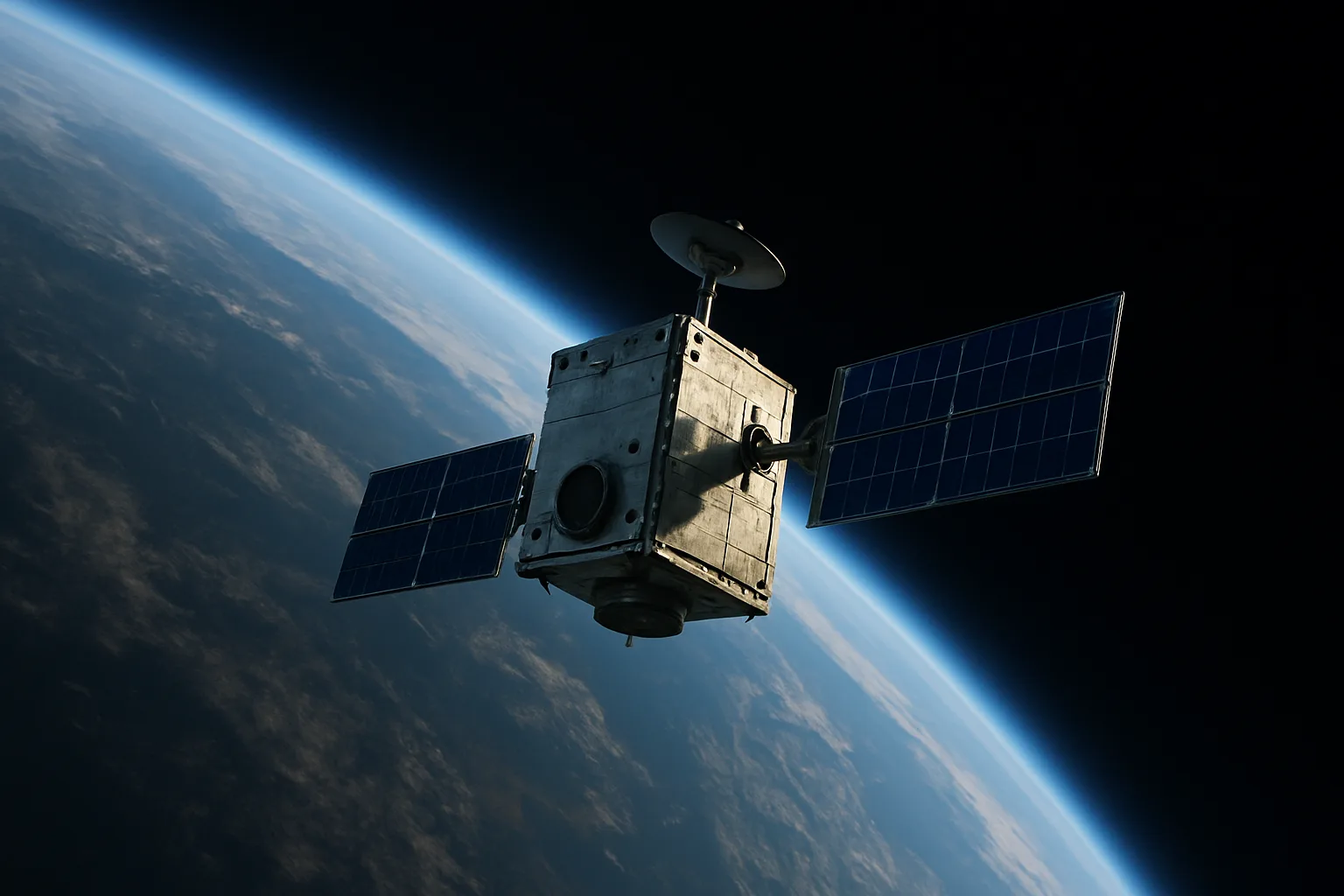
A satellite doesn’t escape Earth’s gravity. It stays in orbit because it is moving sideways so quickly that, as gravity pulls it downward, the curved Earth drops away beneath it. In a sense, a satellite is always falling—but it keeps missing the ground.
That simple idea explains why spacecraft can circle Earth for years without engines constantly pushing them along. Orbit is not a place where gravity stops working. It is a carefully balanced kind of free fall, shaped by speed, altitude and the small forces that can gradually change a spacecraft’s path.
A fall that goes all the way around Earth
Imagine throwing a ball forward. It moves ahead as gravity pulls it down, so it eventually hits the ground. Throw it faster, and it travels farther before landing. If you could throw it fast enough—and there were no mountains or air in the way—the ground would curve away at the same rate the ball falls. The ball would keep going around Earth.
This thought experiment is often associated with Isaac Newton, who used it to illustrate how the same force that pulls an object toward the ground can also govern the motion of the Moon and planets. A real satellite follows the same basic principle: it has forward motion, while Earth’s gravity continually bends that motion into a curved path.
For a circular orbit, gravity provides the inward acceleration needed to keep the satellite moving around Earth rather than off in a straight line. The satellite’s speed keeps it from plunging directly down; gravity keeps it from simply flying away. Neither force switches off.
How fast does a satellite need to go?
The required orbital speed depends on how far the satellite is from Earth’s center. For a low circular orbit, a spacecraft travels at roughly 7.8 kilometers per second—about 28,000 kilometers per hour. The International Space Station, which orbits a few hundred kilometers above Earth, takes about 90 minutes to complete one lap.
At greater altitudes, the needed circular-orbit speed is lower. But a satellite farther out also has a longer route to travel, and it takes more time to complete an orbit. That is why satellites in different orbits can have very different speeds and purposes.
Not every orbit is a perfect circle. Some are elliptical, with the satellite closer to Earth at one point and farther away at another. In an elliptical orbit, the satellite speeds up as it approaches Earth and slows down as it moves away. It is still responding to gravity and carrying its motion forward, but its distance and speed change through each circuit.
Why satellites don’t need to keep their engines running
A satellite needs a powerful launch to reach the right altitude and gain the right sideways speed. Once it is in a stable orbit, it can keep moving without continuous thrust. In space, there is very little resistance to slow it down, so the motion it already has can continue.
This is an example of inertia: an object in motion keeps moving unless a force changes its motion. Engines are important for reaching orbit and for making adjustments, but they are not usually needed to push a satellite around every part of its path.
Space is not perfectly empty, however. Even low Earth orbit contains traces of the upper atmosphere. Collisions with these sparse gas particles create drag, gradually taking energy from a satellite’s orbit. Solar activity can heat and expand the upper atmosphere, increasing drag at a given altitude. Over time, an orbit can shrink until the satellite reenters the denser atmosphere and burns up or, for some objects, reaches the surface.
Satellites may also use small thrusters to adjust their paths. A spacecraft can make corrections to keep to its intended orbit, avoid a predicted collision, or move to a different orbit. These are occasional maneuvers, not constant engine-powered flight. The amount of adjustment needed depends on the satellite’s orbit and mission.
Why some satellites seem to hover
A satellite in geostationary orbit travels around Earth once per day, in the same direction that Earth rotates. From the ground, it appears to stay above roughly the same point on the equator. That makes geostationary satellites useful for communications and weather monitoring, since antennas or instruments can keep looking toward the same region.
This orbit is much higher than the one used by the International Space Station: about 35,786 kilometers above Earth’s surface. The satellite is not hovering in the everyday sense, and Earth’s gravity is still acting on it. Its speed and distance combine to give it an orbital period that matches Earth’s rotation.
Other satellites use low or medium Earth orbits, depending on what they need to do. A low orbit can provide detailed views of Earth or reduce the time signals take to travel, while a higher orbit can give a satellite a broader view. There is no single best orbit; the right one depends on the job.
What happens when a satellite loses its orbit?
A satellite does not usually drop straight down when its orbit changes. If drag slows it, the spacecraft loses orbital energy and its path changes, generally bringing it into a lower orbit. In that lower orbit, it moves faster along its path, even though it has lost energy overall. If the orbit continues to decay, it eventually dips into thicker air, where drag grows rapidly and reentry follows.
Some satellites are designed to spend fuel near the end of their working lives to move into a safer disposal orbit or guide them toward reentry. The exact plan varies with the satellite and its orbit. Spacecraft operators also track objects in orbit because collisions can damage satellites and create additional debris.
Orbit is falling—with a very good aim
The surprising answer is that satellites stay up not by avoiding gravity, but by using it. Their forward speed carries them around Earth while gravity continually turns their path inward. With too little sideways speed, an object falls back; with the right speed and altitude, it keeps circling.
That balance is not always permanent. Thin atmospheric drag and other small influences can shift an orbit, and satellites may need occasional corrections. But as long as the spacecraft has enough forward motion and follows a suitable path, its fall can continue around Earth rather than ending on it.
You might also like
Why Earth Has Seasons Despite Its Nearly Circular Orbit
Earth’s orbit barely changes its distance from the Sun over the year. The real cause of the seasons is the tilt of our planet’s axis—and the way it changes sunlight.

How Do Mushrooms Seem to Appear Overnight?
Mushrooms don’t grow from nothing in a single night. Their hidden fungal network can produce visible fruiting bodies quickly when conditions are right.

How Tidal Bores Send Waves Upstream
A tidal bore forms when a rising tide is funneled into a shallow river mouth, steepening into a moving front that can surge against the river’s flow.