What Makes Clouds Float Despite Their Enormous Weight?
By WowPebble Editorial
A cloud can contain a surprising amount of water, yet stay aloft. The secret lies in tiny droplets, rising air and the way clouds are spread through the sky.
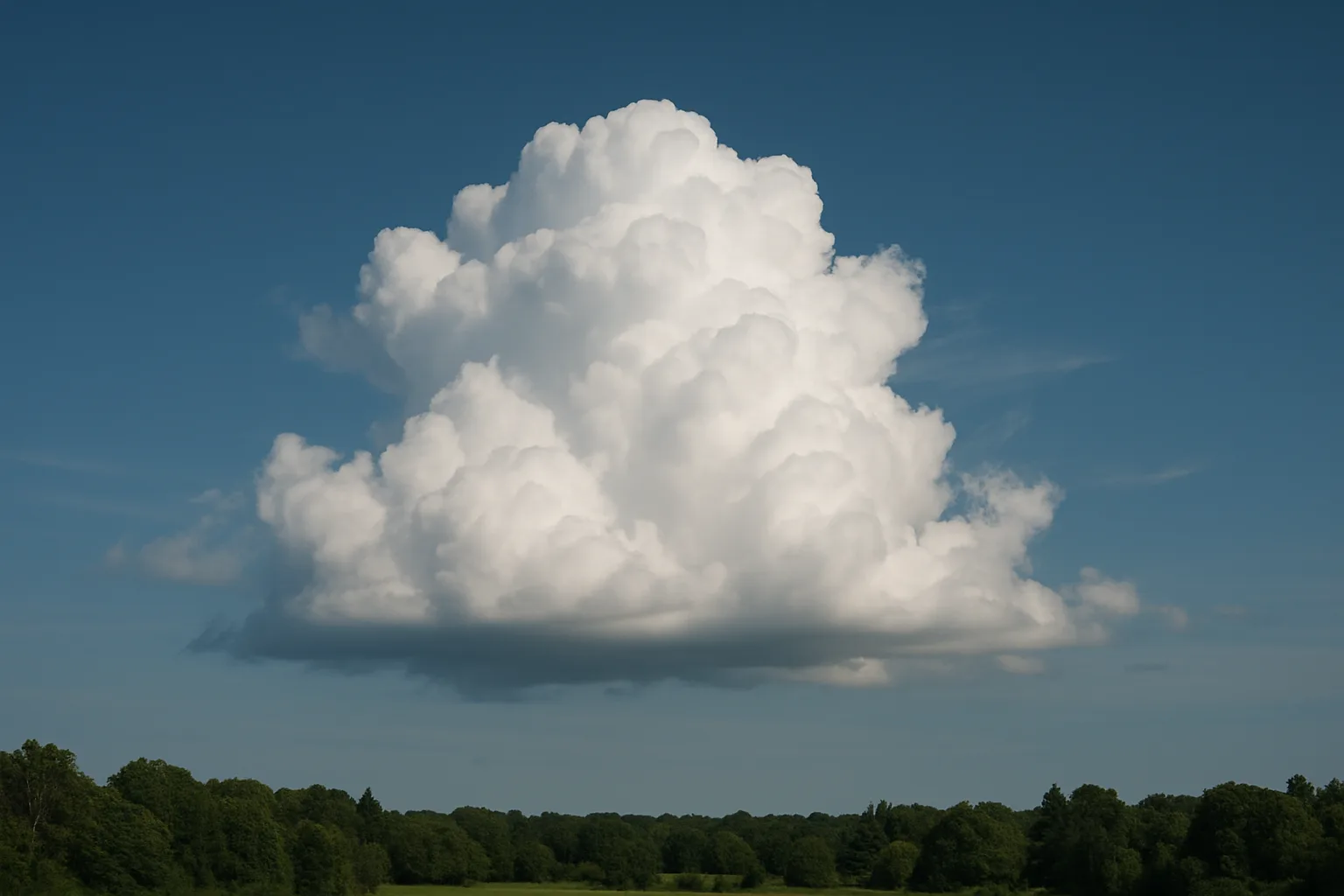
Clouds can look like giant heaps of cotton, and some contain hundreds of tonnes of water. So why don’t they drop out of the sky? The short answer is that a cloud is not one heavy object being held up like a balloon. It is a vast collection of tiny water droplets or ice crystals, suspended in moving air. Their small size makes them fall very slowly, while rising air currents help keep them aloft.
The apparent puzzle comes from picturing a cloud as a solid mass. In reality, most of its volume is air. The water is divided into countless minute particles spread across a large space, and the cloud’s shape is continually changing as air moves through it.
A cloud’s weight is spread over a huge volume
A cloud’s water content can be surprisingly high when added together. As an illustration, a cubic kilometre of cloud with a liquid-water content of 0.5 grams per cubic metre would contain about 500,000 kilograms of water—roughly 500 tonnes. Actual clouds vary greatly in size and water content, so this is an example, not a standard weight for every cloud.
That total sounds immense, but it is distributed through a cubic kilometre of air. The droplets are separated from one another rather than packed into a solid block. If you were inside a typical cloud, you would not be standing under a dense ceiling of water. You would be surrounded by mist-like droplets, with plenty of air between them.
This is also why a cloud’s visible outline can be misleading. The edge is not a firm boundary. It marks a region where enough droplets or crystals are present to scatter light and make the cloud visible. At the edges, cloud particles may be forming or evaporating as the air mixes with its surroundings.
Tiny droplets fall very slowly
Cloud droplets are small—often around 10 to 20 micrometres across. A micrometre is one-millionth of a metre. At that scale, air resistance has a strong effect on a droplet’s motion. Instead of dropping quickly like a raindrop, a small cloud droplet settles through still air at only a slow pace, generally on the order of centimetres per second or less.
Gravity still pulls each droplet downward. The droplets do not escape gravity or become weightless. But as they fall, air pushes against them. Soon, this drag balances the pull of gravity, and the droplet reaches a steady, slow falling speed called its terminal velocity.
Clouds, meanwhile, rarely sit in perfectly still air. Gentle updrafts and turbulent currents can move air upward faster than tiny droplets settle downward. From the ground, the cloud may seem to hang in place, even though its particles are constantly moving and changing.
Rising air helps clouds form and stay aloft
Most clouds develop when air rises and cools. Air can be lifted by heating at the ground, by wind forced over hills or mountains, or by larger weather systems. As the air rises, the surrounding pressure falls, so the air expands and cools.
Cooler air can hold less water vapour than warmer air. When rising air cools enough, some of its invisible water vapour condenses onto tiny particles in the atmosphere, such as dust or salt. These droplets—or ice crystals in cold conditions—make a cloud visible.
The upward motion that helped form the cloud can also help keep its particles suspended. In a growing cumulus cloud, for example, warm air rises from below and may carry droplets upward. The cloud is not a fixed object being propped up; it is part of a moving atmosphere, with water continually condensing, travelling and evaporating.
Humidity plays a role in air’s density, too. At the same temperature and pressure, air containing more water vapour is less dense than dry air, because water-vapour molecules are lighter on average than the main gases in dry air. But temperature and surrounding conditions matter as well: moist air is not automatically buoyant in every situation. What matters is how the air parcel’s overall density compares with the air around it.
Why clouds sometimes turn into rain
Cloud droplets usually remain tiny because they do not immediately combine into large drops. In many clouds, however, droplets collide and merge. As they grow, they become heavier and their terminal velocity increases. Eventually, rising air can no longer keep them suspended, and they fall as rain. Ice crystals can also grow and contribute to precipitation, depending on the cloud’s temperature and structure.
This is why a cloud can produce rain without the entire cloud falling. Precipitation forms when some particles grow large enough to descend, while other droplets and crystals remain suspended or evaporate. Rain is not a cloud tipping over; it is the result of water particles growing and moving out of the cloud faster than air currents can carry them upward.
Clouds can also disappear without raining. If dry air mixes into a cloud, its droplets may evaporate back into invisible water vapour. Changes in temperature or airflow can have the same effect. The cloud’s visible form fades, but the water does not vanish—it returns to the surrounding air.
A cloud is a moving process, not a floating object
The simplest way to understand a cloud is to think of it as a region of atmosphere where tiny particles of water or ice are present. Gravity pulls those particles down, drag slows their fall, and air currents move them around. At the same time, droplets form, merge, evaporate or freeze.
So clouds do not float because their enormous weight is somehow cancelled. Their water is spread across an enormous volume, and each particle is small enough to fall slowly. In many clouds, rising air and turbulence keep droplets and crystals suspended. The cloud’s apparent stillness is an illusion created by a constantly changing balance between gravity, airflow and the water cycle.
You might also like
Why Do Water Towers Stand So High Above the Ground?
Water towers use gravity to keep water moving and maintain pressure in pipes. Their height helps supply homes, businesses and hydrants across a community.

How Do Mushrooms Seem to Appear Overnight?
Mushrooms don’t grow from nothing in a single night. Their hidden fungal network can produce visible fruiting bodies quickly when conditions are right.
How Tidal Bores Send Waves Upstream
A tidal bore forms when a rising tide is funneled into a shallow river mouth, steepening into a moving front that can surge against the river’s flow.