Why Do Water Towers Stand So High Above the Ground?
By WowPebble Editorial
Water towers use gravity to keep water moving and maintain pressure in pipes. Their height helps supply homes, businesses and hydrants across a community.
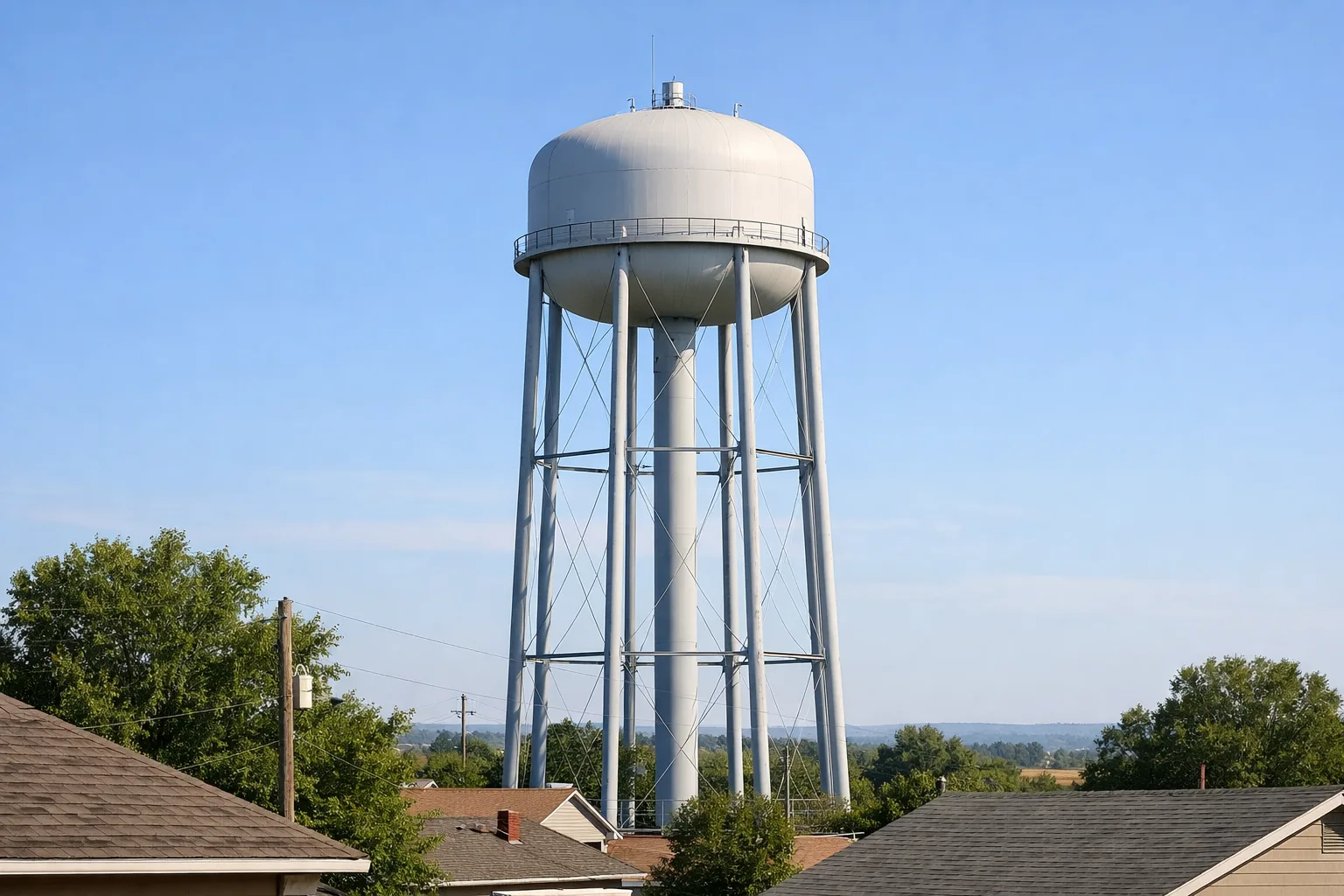
A water tower is more than a storage tank with an unusually tall support. Its height helps a community’s water system maintain pressure: water stored high above the ground can flow downhill through pipes under the pull of gravity. That means pumps do not have to push every gallon directly to every tap, every moment of the day.
The tower also acts as a reserve, helping the system cope with changing demand. Its elevated position is what makes that stored water useful—not just as a supply, but as a source of pressure.
How height creates water pressure
Water pressure in a pipe depends in part on the difference in elevation between the water’s surface and the outlet. The greater that vertical distance, the more pressure gravity can produce. In a typical water system, each foot of water height adds roughly 0.43 pounds per square inch (psi). Put another way, about 2.3 feet of height produces 1 psi.
A tower’s tank may be only partway full, so engineers consider the height of the water inside it, not just the top of the structure. As the water level drops, the pressure it can provide drops too. The tank is filled again to keep pressure within the range the system needs.
That pressure pushes water through the network of pipes beneath streets and into buildings. It helps deliver water to ordinary taps, as well as to places where demand can surge, such as fire hydrants. The tower does not send water directly to each building; it supports pressure across a connected distribution system.
Why not pump water straight from the treatment plant?
Pumps are essential to most modern water systems, but relying on them alone would mean matching water production and pumping to demand at every moment. Demand changes throughout the day: many people may use water around the same time, while demand can be lower at other hours. A tower helps smooth out those swings.
Pumps can fill the elevated tank when the system has water available and the tank needs replenishing. When demand rises, water can flow out of the tank and into the network. The tower therefore works as a buffer between pumping and everyday use. It can also help a system continue supplying some water temporarily if a pump stops or power is interrupted, although how much service remains depends on the system and how much water is stored.
Raising water takes energy. A pump must lift water to the tank, but once the water is elevated, gravity helps move it through the pipes. The tower’s stored water also gives operators a reserve to draw on rather than requiring pumps to respond instantly to every short-lived increase in demand.
The tower’s height is a practical calculation
There is no single height that works for every water tower. Engineers need to provide adequate pressure at the homes and businesses served, including places that are higher up or farther from the source. They also have to account for pressure lost as water travels through pipes and fittings.
Too little pressure can make water flow weakly or fail to reach higher floors. Too much pressure can put unnecessary strain on pipes and plumbing. In areas with substantial changes in elevation, one tower may not be the right solution for the whole community. Water systems can instead use separate pressure zones, additional pumping, or other equipment to manage service at different heights.
This is why a tower’s appearance does not tell the whole story. The support may look extremely tall, but the important engineering question is how high the water surface sits compared with the parts of the network it serves. The shape of the tank and the local landscape matter too.
Why build a tank in the air?
An elevated tank uses gravity without requiring the entire supply to be stored on a hill. In flat places, where natural high ground is scarce, a tower creates an artificial height. In hilly areas, water systems may use naturally elevated reservoirs or place tanks at strategically high locations instead.
The tower also keeps a supply close to the distribution network. A large reservoir at ground level can store water, but it does not provide the same pressure by gravity unless it sits above the area it serves. A ground-level reservoir may still be part of a system, with pumps lifting water onward to a tower or other elevated storage.
Water towers are not the only way to maintain pressure. Some systems rely more heavily on pumps, and many use a combination of storage and pumping. The right arrangement depends on local terrain, the layout of the pipes, demand and the desired pressure range.
Why are water towers often filled at night?
Some water systems can use quieter periods to replenish storage, but operating schedules vary. A tower can be filled whenever the system needs it and conditions allow. The goal is to keep enough water in the tank to support normal demand and provide a useful reserve, not to follow one universal timetable.
During busy periods, water may leave the tank faster than it enters. When demand eases, pumps can restore the level. This cycle helps the system handle short-term peaks without building enough pumping capacity to meet the highest possible demand continuously.
More than a landmark
Water towers have become familiar features of many town and city skylines. Their distinctive silhouettes can make them local landmarks, but their main purpose is practical: they hold water high enough to help gravity maintain pressure in a distribution system.
The next time you see one, imagine the water inside as stored energy. Pumps lift it into place; gravity helps carry it back down. That simple exchange makes the tower a useful combination of storage, pressure support and backup—one reason these tall structures remain part of water infrastructure.
You might also like
What Makes Clouds Float Despite Their Enormous Weight?
A cloud can contain a surprising amount of water, yet stay aloft. The secret lies in tiny droplets, rising air and the way clouds are spread through the sky.

Why Do Mirrors Reverse Left and Right but Not Up and Down?
A mirror does not actually swap left and right. It reverses the direction pointing into the glass—and the way we compare ourselves with the reflection creates the illusion.

Why Does a Retractable Pen Click When You Press It?
A retractable pen’s click comes from a small locking mechanism inside its barrel. Here’s how the button, cam and spring work together to extend and retract the tip.