What Causes the Green Flash at Sunset?
By WowPebble Editorial
The green flash is a brief effect at the Sun's edge. Explore its atmospheric explanation through documented images, without unsafe direct solar viewing.
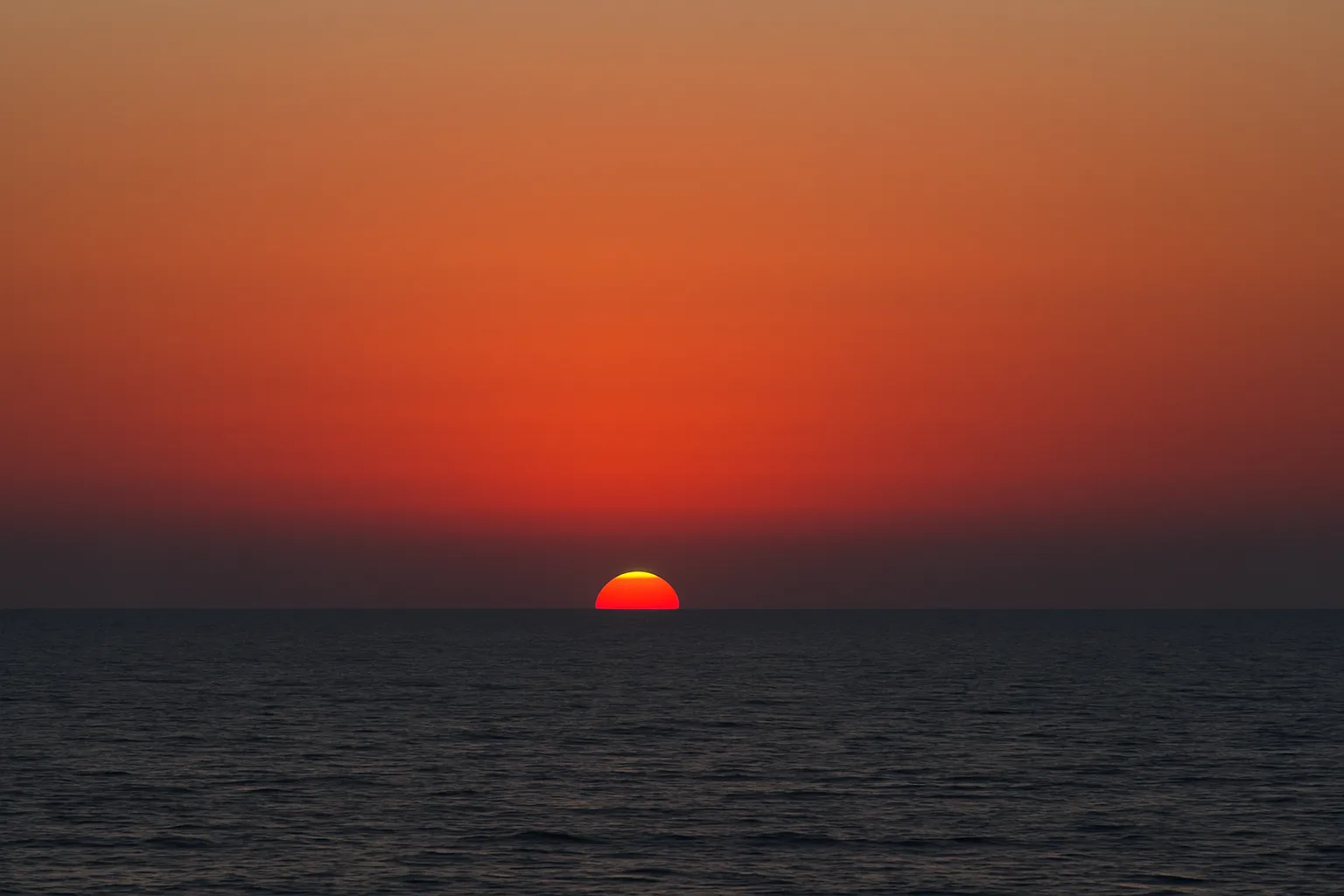
For a fleeting moment, the last edge of the setting Sun can turn green. This rare-looking glimpse isn’t a trick of the eye or a flash from the Sun itself: it happens because Earth’s atmosphere bends and filters sunlight as it travels toward us. Under the right conditions, those effects leave a green sliver visible just after the rest of the Sun has disappeared below the horizon.
The atmosphere acts like a lens
Sunlight may look white, but it contains a range of colors. As it passes through Earth’s atmosphere, it changes direction—a process called refraction. The atmosphere is densest near the ground, so light bends as it travels through layers of air with different densities. The effect is strongest when the Sun is near the horizon, because its light has to pass through a much longer stretch of atmosphere than it does when the Sun is high in the sky.
Dispersion produces a narrow coloured rim, but that alone is not the full explanation of a visible flash. Andrew Young’s optical explanation describes the common forms as mirage-magnified images of that rim. Air-layer structure matters as well as wavelength-dependent bending.
The atmosphere also bends different colors by slightly different amounts. This effect, called dispersion, is related to the way a glass prism separates white light into a rainbow. In the atmosphere, the separation is far subtler: the colored images of the Sun lie almost on top of one another. But near the horizon, the green edge can appear just above the red edge.
As the Sun sinks, the lower parts of its apparent disk disappear first. The colors don’t all vanish at exactly the same time, and the upper edge may briefly show green after the brighter disk has dropped below the horizon. The flash usually lasts only a moment because the Sun is still moving down, carrying that final green rim out of sight.
Why don’t we see blue instead?
Atmospheric bending alone does not explain the usual colour. Andrew Young’s scattering account describes how shorter wavelengths are preferentially removed from direct sunlight on its long atmospheric path near the horizon. Blue and violet can therefore be too faint to see while green remains visible. Exceptionally clear conditions can produce other colours; “green flash” is not a promise that every flash is green.
The exact appearance depends on the atmosphere. Haze, dust, clouds, and turbulence can blur or weaken the colored edge. A clear, sharply defined horizon gives the light a better chance of reaching your eyes without being obscured. That’s why observers often look out over the sea: the horizon can be broad and unobstructed, and the distant view may offer a clean line where the Sun sets.
A quick flash, not a green Sun
A typical flash is a brief colour effect at the Sun's apparent edge, not a change in the Sun's own emission or a uniform glow across the twilight sky. Refraction can also flatten or distort the apparent solar image. Different kinds of flash and mirage need their own geometry; one simple drawing does not describe every display.
Green flashes can happen at sunrise as well as sunset, when the Sun is just appearing above the horizon. They are most often discussed as sunset events because the final seconds of daylight give observers a clear moment to watch the Sun’s upper edge disappear. The effect is real, but sightings are easy to miss: it requires a view of the horizon, suitable atmospheric conditions, and good timing.
How to improve your chances of seeing one
Use photographs or a properly supervised observing arrangement to study a green flash. Do not try to catch it with an unprotected glance at the Sun: NASA warns that even a quick look can damage the eye. Ordinary sunglasses, low altitude and absence of discomfort do not establish safety. Binoculars, telescopes and camera viewfinders require the correct equipment and guidance too.
When examining a documented image, look for a clear horizon, the shape of the solar edge and evidence of atmospheric distortion. Andrew Young’s atmospheric-optics account explains that common visible green flashes involve mirage magnification of a much smaller coloured rim. Colour separation alone does not describe the full appearance of those displays. Avoid treating a photograph's camera-rendered colour as a measurement of what an unaided observer saw.
Why the name sounds more dramatic than the event
The phrase “green flash” suggests a bright burst, but many sightings are simply a small green spot or rim at the Sun’s upper edge. It can be vivid when conditions are favorable, yet it may also be subtle enough to question whether you saw it at all. Photographs can capture the effect, although camera settings and atmospheric distortion can change how the colors appear.
Dispersion separates the apparent colours, atmospheric extinction changes which reach the observer, and mirage geometry can make a narrow rim easier to distinguish. The particular atmosphere and viewing geometry govern the appearance and duration; a brief photograph does not establish a universal time limit.
You might also like

How Do Mushrooms Seem to Appear Overnight?
Mushrooms don’t grow from nothing in a single night. Their hidden fungal network can produce visible fruiting bodies quickly when conditions are right.
How Tidal Bores Send Waves Upstream
A tidal bore forms when a rising tide is funneled into a shallow river mouth, steepening into a moving front that can surge against the river’s flow.

Why Chameleons Change Color—and What the Colors Signal
Chameleons change color to communicate, respond to temperature and light, and sometimes blend in. Their shifting shades come from both pigments and remarkable skin cells.