How to Tell If an Egg Is Fresh Without Cracking It
By WowPebble Editorial
A bowl of water can offer a clue to an egg’s age—but it can’t prove the egg is safe. Learn what the float test, shell, and carton can tell you.
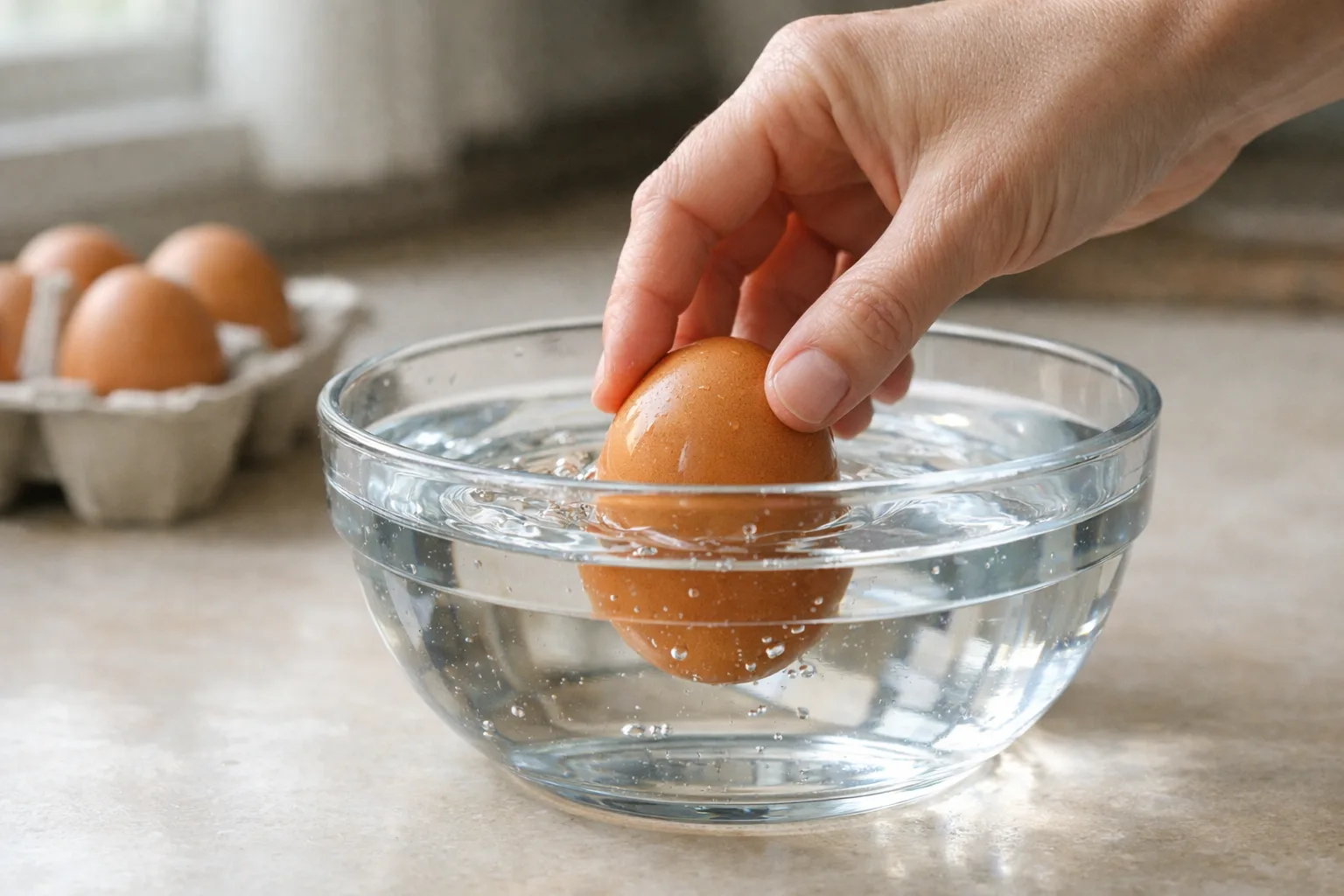
An egg can look much the same on the outside whether it was laid recently or has been sitting in the fridge for weeks. A simple bowl of water can give you a useful clue: as an egg ages, the air pocket inside it grows, making it more likely to stand upright or float. But the test has limits. It estimates age; it does not tell you whether an egg is safe to eat.
Freshness is not a safety test. USDA explains that floating reflects an enlarged air cell and may occur in an egg that is still usable; sinking does not guarantee that harmful microbes are absent. Use the carton, storage and safe-cooking guidance as well as any observation about age. Do not taste-test an egg to decide whether it is safe.
Here’s how to check an egg without cracking it—and how to interpret what you find.
Try the water test
Fill a bowl with cold water deep enough to cover the egg. Lower the egg in gently and watch what it does:
- It sinks and lies on its side: The egg is likely quite fresh.
- It sinks but stands upright: It is older, but that alone does not mean it has spoiled.
- It floats: It is older still. Consider discarding it, especially if you’re unsure how it has been stored.
The reason is the air cell: a small pocket of air inside the shell, usually at the wider end of the egg. An eggshell is porous, so over time moisture and gas escape and air enters. The air cell grows, making the egg more buoyant.
The water test is a rough guide, not a precise clock. It can’t tell you exactly when an egg was laid, and it can’t detect every kind of spoilage or harmful bacteria. A floating egg is a strong sign that it is old, but the test does not prove that a sinking egg is safe.
If you use the test, do it just before you plan to use the egg. Don’t treat a water-tested egg as washed or preserved, and don’t put it back in the carton wet.
Check the carton and the shell
Before relying on a household test, look at the information on the carton. Depending on where you live, it may show a use-by, best-before, or pack date. These labels have different meanings under different local rules, so check the guidance for your region. In the United States, for example, a “sell-by” date is primarily for retailers, not a direct test of whether an egg is safe at home.
Storage matters, too. Eggs kept consistently refrigerated tend to stay in good condition longer than eggs left at room temperature. Follow the storage advice on the package and your local food-safety guidance. If you’re not sure whether eggs have been kept cold, don’t use a float test to settle the question.
Inspect the shell in good light. Avoid eggs with cracks, leaks, or sticky residue. A shell that looks clean and intact is preferable, but it cannot guarantee what is inside: contamination may not be visible, and an uncracked egg can still be unsafe if it has been mishandled.
Use a light to candle the egg
Candling is a traditional way to inspect an egg without opening it. In a dim room, hold a bright light against the wider end of the shell. A small flashlight can work if it is bright enough. The light may reveal the outline of the air cell and, sometimes, cracks or unusual movement inside. A large air cell generally indicates an older egg.
Commercial egg graders use candling as part of inspection, but a home flashlight is not a substitute for professional equipment. Results can be hard to see, especially through darker or thicker shells. Like the water test, candling can offer clues about age and condition but cannot confirm that an egg is free of harmful bacteria.
The USDA grading manual is a training document for evaluating egg quality with candling equipment. It does not turn a home flashlight into a safety test. Health Canada also warns that an egg can look clean while contaminated; regional storage guidance and safe preparation still apply.
Freshness and safety are not the same thing
This is the most important point: no check you can do through an intact shell can guarantee that an egg is safe to eat. The water test and candling are about clues to age and quality, not a way to identify every food-safety risk.
An egg may be old without being spoiled, while an egg that seems fresh may still be unsafe if it was cracked, contaminated, or stored improperly. Keep eggs refrigerated when that is the recommended practice where you live, and discard eggs that are cracked or have been left out longer than food-safety guidance allows. When in doubt about storage or the egg’s condition, the safest choice is to throw it away.
If you do decide to use an egg, crack it into a separate clean bowl rather than directly into other ingredients. Once opened, an unpleasant or unusual odor is a reason to discard it. But don’t taste an egg to test whether it is safe, and remember that the absence of a bad smell does not rule out harmful bacteria.
What the tests can—and can’t—tell you
For a quick household check, the water test is the easiest: an egg that lies flat is likely fresher than one that stands upright or floats. The shell and carton can add context, while candling may let you see a growing air cell without opening the egg.
Together, these checks help you judge an egg’s likely age. None can certify its safety. Store eggs properly, follow the dates and guidance on the carton, and treat signs of damage or uncertainty about storage seriously. That way, a simple test stays useful without being mistaken for a guarantee.
You might also like

How to Tell If a Watermelon Is Ripe Before You Cut It
A ripe watermelon gives a few useful clues before you slice it. Learn how to check its field spot, weight, shape and sound—and which signs to treat cautiously.
What to Keep in a Home Kit for a Power Outage
Build a practical outage kit with lighting, charged power banks, water, easy-to-eat food, essential medicines and supplies suited to your household.
How to Clean a Humidifier and Stop Mineral Buildup
Clean your humidifier regularly to remove scale and reduce residue. Learn how to descale it safely, care for filters and prevent mineral buildup.