How to Measure a Room’s Floor Area, Including Alcoves
By WowPebble Editorial
Measure a room with a tape or laser, sketch its outline, then split it into simple shapes. Here’s how to include alcoves without counting any floor twice.
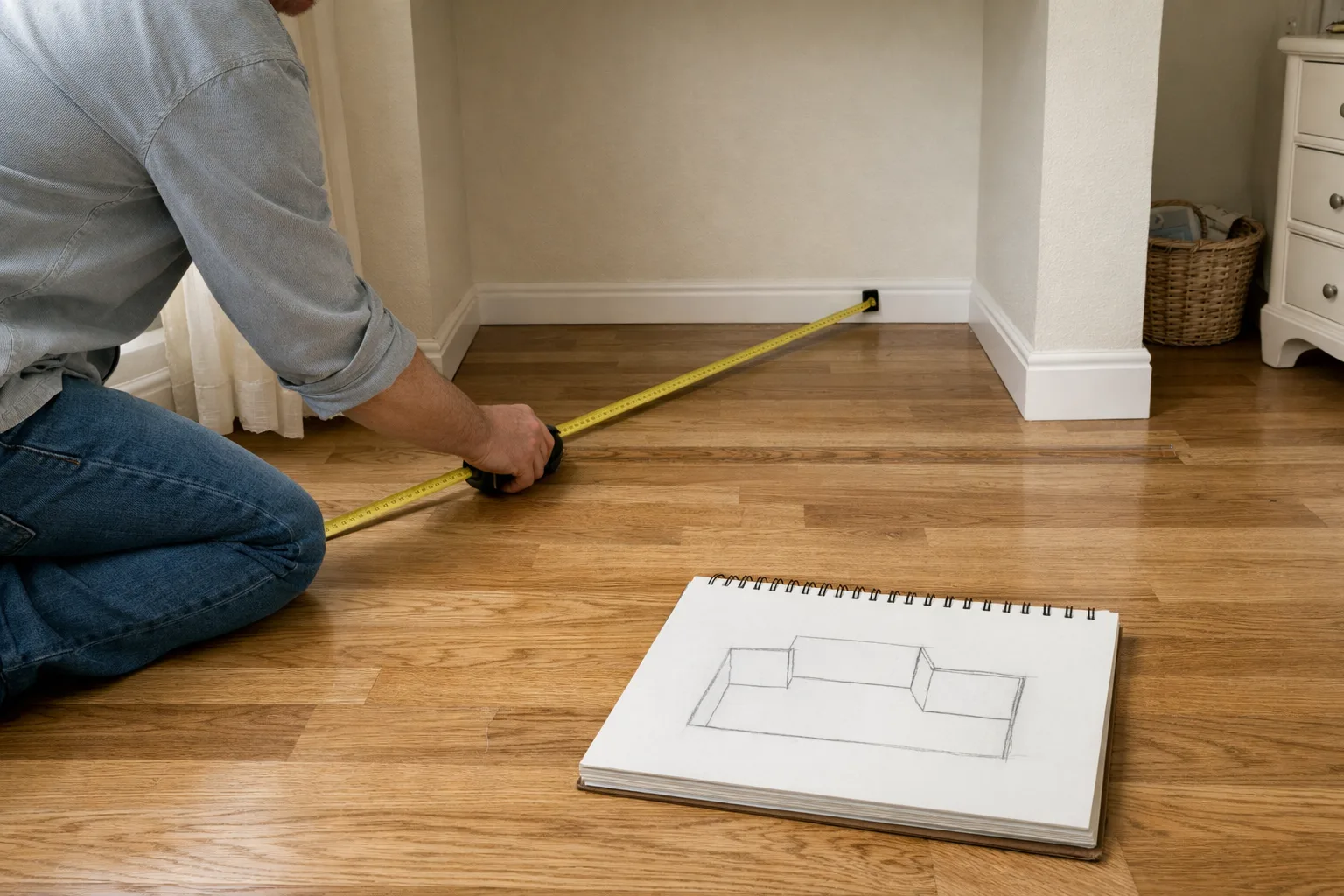
To measure a room’s floor area, sketch its outline, split it into rectangles, and add their areas together. An alcove that extends beyond the room’s main rectangle counts too: measure its width and depth, calculate its area, and add it to the total.
What you’ll need
Use a tape measure or a laser measure, a pencil, and paper. A calculator helps, especially if the room has several recesses or an uneven shape.
Measure in one unit throughout—metres, centimetres, feet, or inches. For the final area, use square units, such as square metres or square feet. If you measure in centimetres, divide the result in square centimetres by 10,000 to get square metres.
Sketch and measure the outline
Stand at the room’s entrance and draw a simple plan as if you were looking down at the floor. Mark each corner, recess, and alcove. It does not need to be to scale; its purpose is to help you keep track of the measurements.
Measure along the floor from one finished wall face to the opposite one. For each rectangle in your plan, you need its length and width. In an alcove, measure from the back wall to the point where the recess opens into the main room, as well as across the alcove’s width.
For an uneven room, measure each section separately. Avoid assuming that the room is square just because one pair of sides matches. If a wall or alcove is angled, mark that section on the sketch and use the triangle method below rather than treating it as a rectangle.
Divide the room into simple shapes
Draw lines on your sketch to split the floor into rectangles that do not overlap. Calculate each rectangle using:
Area = length × width
Add the results. An alcove that sticks out from the main rectangular outline is an extra rectangle, so add its area. If the outline instead has a cut-out that is not part of the floor you want to count, subtract that section. Take care not to include the same patch of floor in two rectangles.
Hypothetical example: Suppose a room’s main rectangle measures 4 m by 3 m, and an alcove extending beyond it measures 1 m by 0.8 m. The main area is 4 × 3 = 12 m². The alcove is 1 × 0.8 = 0.8 m². Together, they make 12.8 m².
Include a triangular section correctly
For a triangular piece, choose one side as the base. Measure the perpendicular distance from that base line to the opposite corner: this is the height, not the length of the sloping side. The triangle formula is half the base multiplied by that height.
Separate hypothetical example: A triangular recess with a base of 2 m and a perpendicular height of 0.6 m has an area of 2 × 0.6 ÷ 2 = 0.6 m². Add it only if that triangle lies outside the main rectangle; subtract it if it represents a missing corner inside an enclosing rectangle. These examples are assumed dimensions, not measurements of a real room.
If the boundary is curved or the shape cannot be measured reliably as these pieces, this simple method provides an estimate rather than a precise result. Use a measured plan or obtain help for an exact quantity; do not disguise an estimate by adding decimal places.
Decide what area you need
For a general floor-area measurement, trace the floor boundary you intend to count and use that boundary consistently. A measurement for a floor-covering project may use a different boundary from an official property or building measurement; conventions can vary. If you are measuring for a listing, renovation plan, or formal calculation, check which definition is required.
For flooring, the measured area is a starting quantity, not necessarily the exact amount to buy. Cutting and fitting can require extra material, depending on the product and the layout. Follow the flooring supplier’s guidance for any additional allowance rather than adding it to the room’s stated floor area. Quick-Step’s measuring advice likewise treats cutting waste separately from the room measurement.
You might also like
How to Measure for Curtains Before You Order or Sew
Get curtain measurements right the first time. Learn how to measure width and length, choose fullness, account for hardware, and avoid common ordering mistakes.
What to Keep in a Home Kit for a Power Outage
Build a practical outage kit with lighting, charged power banks, water, easy-to-eat food, essential medicines and supplies suited to your household.
How to Clean a Humidifier and Stop Mineral Buildup
Clean your humidifier regularly to remove scale and reduce residue. Learn how to descale it safely, care for filters and prevent mineral buildup.