How Solar Panels Turn Sunlight Into Electricity
By WowPebble Editorial
Solar panels don’t simply store sunlight or turn it into heat. They use a semiconductor to free electrons and create an electric current you can use.
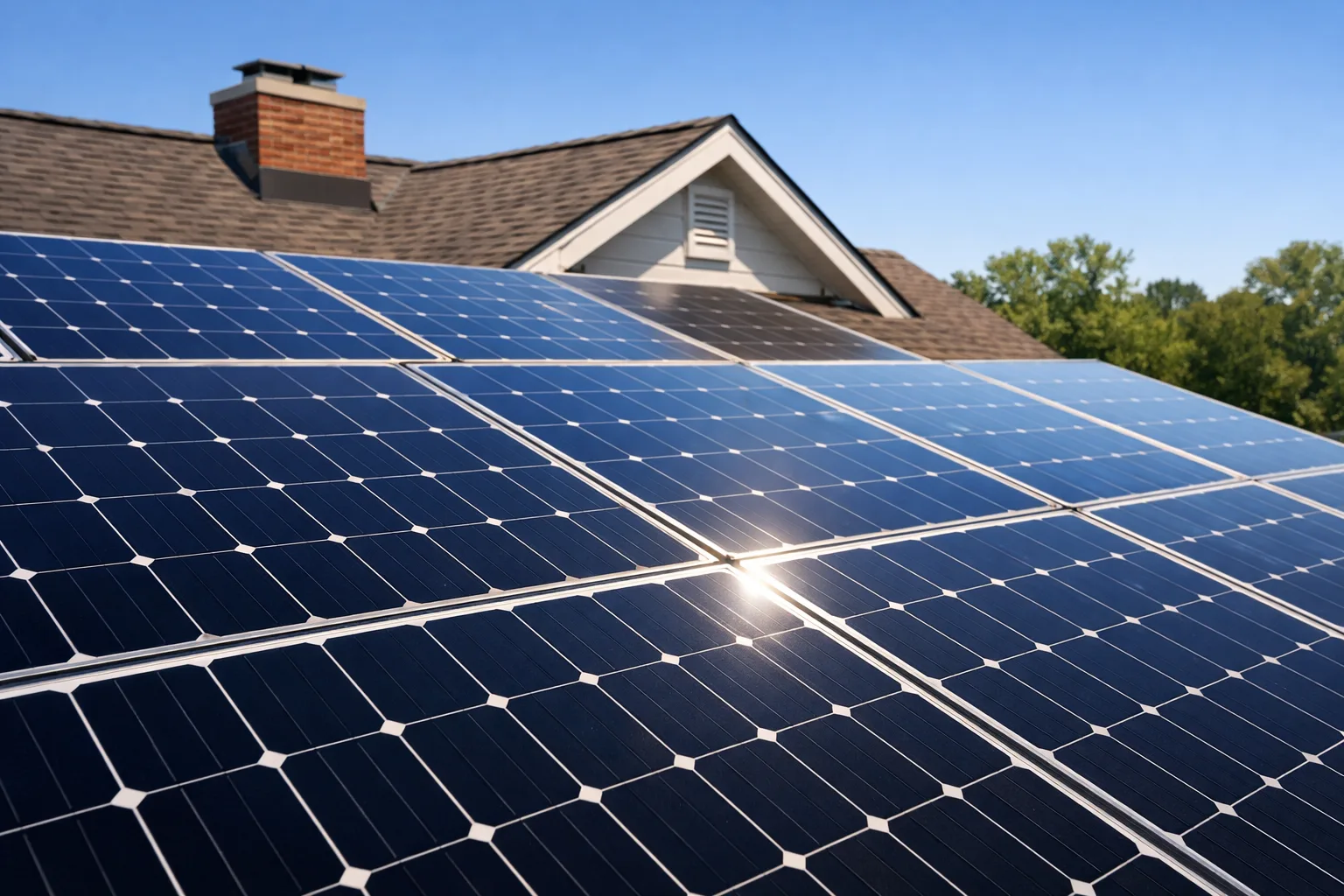
Solar panels make electricity from sunlight without moving parts, burning fuel, or needing to heat water. The key is a material inside each solar cell that responds to light by setting tiny electric charges in motion. Once those charges flow through a circuit, they can power lights, appliances, and other equipment.
This process is called the photovoltaic effect. Understanding it reveals why a panel can generate electricity on a cool, bright day, why an inverter is usually part of a solar system, and why shade can matter so much.
Start with sunlight and a solar cell
A solar panel is made up of many individual solar cells connected together. Most commonly, those cells are made from silicon, a semiconductor: a material that can conduct electricity under certain conditions, but does not conduct as freely as metals such as copper.
Sunlight arrives in packets of energy called photons. When photons reach a solar cell, some are reflected, some pass through, and some are absorbed by the silicon. An absorbed photon can transfer enough energy to an electron in the material to free it from its usual place in an atom. The electron is then able to move through the silicon.
But simply freeing electrons would not produce a useful, steady current. The cell also needs a way to encourage charges to move in a particular direction.
How the cell creates a current
A solar cell is built with two layers of silicon that have been treated slightly differently. This treatment, called doping, changes how each layer behaves electrically. One layer has an abundance of electrons available; the other has spaces where electrons can settle. Where the layers meet, they form a boundary called a junction.
The junction creates an internal electric field. When light frees electrons, that field helps push electrons toward one side of the cell and the corresponding positive charges toward the other. This separation creates an electrical imbalance: a voltage between the cell’s two sides.
Connect those sides through an external circuit and electrons can travel through the circuit from one side to the other. Their movement is an electric current. The electrons then return to the cell, where the process can continue as long as light keeps supplying energy.
In other words, sunlight provides the energy, the cell’s structure separates charges, and the connected circuit gives those charges a path to follow. A single cell produces a limited amount of electrical power, so manufacturers connect many cells to make a panel with a useful output.
From a panel to power in a home
The electricity produced by a solar cell is direct current, or DC. In DC electricity, charges flow in one direction. Many household appliances and the public electricity grid use alternating current, or AC, in which the flow repeatedly changes direction.
That is why a solar power system usually includes an inverter. It converts the panel’s DC electricity into AC electricity that can be used by a home or supplied to the grid. Some systems use a central inverter for a group of panels; others use smaller devices connected to individual panels or pairs of panels.
When the panels produce more electricity than a home is using, the surplus may be sent to the grid or stored in a battery, depending on the system. When the panels are producing too little—at night, for example—the home can draw electricity from storage or the grid. A battery is not needed for a grid-connected solar system to work, though it can provide backup or help shift electricity use to a different time.
Why sunlight, shade, and heat matter
A panel needs light, not warmth. It can generate electricity on a cool, sunny day, and it can still produce some power under cloudy skies because clouds do not block all sunlight. However, less available light generally means less electricity. At night, panels do not produce power because sunlight is absent.
Shade can reduce a panel’s output because it limits the light reaching some of its cells. How much this affects the whole system depends on how the panels are wired and what equipment is used. Modern system designs can help limit the impact of shade on one panel, but they cannot make a shaded cell receive sunlight.
Heat is a separate issue. Solar cells typically become less efficient as they get hotter, so a very hot panel may produce less power than the same panel would at a cooler temperature with similar sunlight. This is one reason a bright, breezy day can be favorable for solar generation.
The direction and angle of a panel also influence how much sunlight it receives over the day and year. Dust, leaves, snow, and other obstructions can reduce the light reaching the cells as well. Solar systems are therefore designed around their location, roof or mounting space, and likely sources of shade.
Why panels do not run out of sunlight energy
A solar cell does not use up the silicon each time it makes electricity. Instead, sunlight repeatedly supplies energy that frees charges, while the cell’s electric field helps direct their movement. The cell can keep working as long as its materials and connections remain in working condition and light reaches it.
This differs from a fuel-burning generator, which makes electricity by converting the chemical energy in fuel and releases exhaust as it operates. A solar panel has no combustion process and no moving parts in the panel itself. Its electricity still depends on sunlight, and making and installing solar equipment requires materials and energy, but the operating process is direct: light in, electrical current out.
The simple idea behind a complex system
The journey from sunlight to usable electricity has a few stages: photons transfer energy to electrons in a semiconductor; a junction separates charges; an external circuit carries the resulting current; and an inverter converts that current into a form suited to a home or grid.
That small-scale process, repeated across many cells and panels, is what makes solar power possible. The technology can look like a sheet of dark glass on a roof, but underneath it is a carefully arranged material turning light into moving electric charge.
You might also like

How Do Mushrooms Seem to Appear Overnight?
Mushrooms don’t grow from nothing in a single night. Their hidden fungal network can produce visible fruiting bodies quickly when conditions are right.

How Tidal Bores Send Waves Upstream
A tidal bore forms when a rising tide is funneled into a shallow river mouth, steepening into a moving front that can surge against the river’s flow.

Why Chameleons Change Color—and What the Colors Signal
Chameleons change color to communicate, respond to temperature and light, and sometimes blend in. Their shifting shades come from both pigments and remarkable skin cells.