How Do Pearls Form Inside Oysters?
By WowPebble Editorial
A pearl isn’t simply a grain of sand coated in shell. It forms when an oyster’s living tissue creates a pearl sac and layers of nacre around an irritant or nucleus.
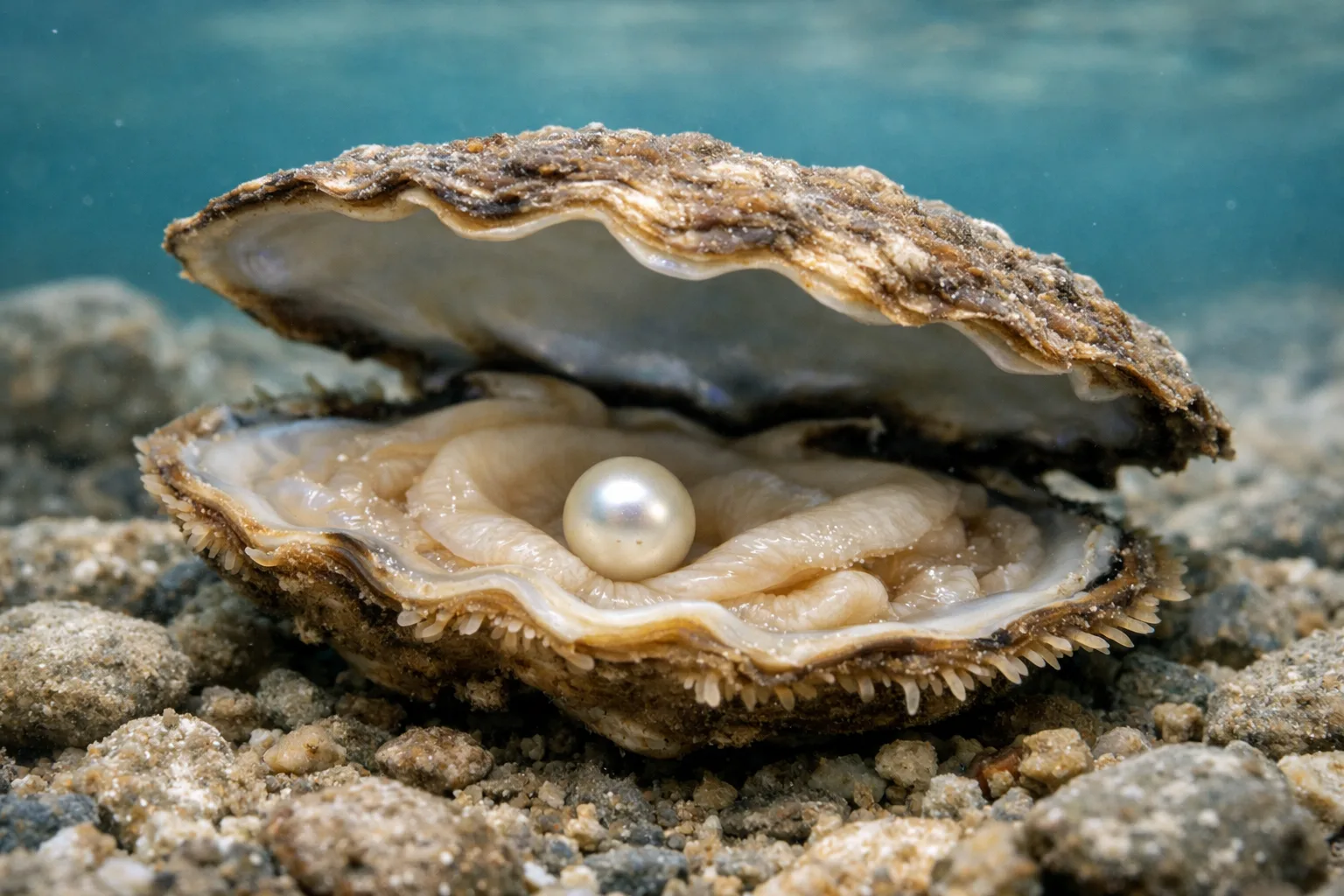
A pearl is made by the same living tissue that lines an oyster’s shell. When that tissue forms a small sac around an irritant or a deliberately placed nucleus, it can build up layer after layer of nacre—the glossy material inside the shell—until a pearl develops. The process is natural, but it isn’t quite the simple “grain of sand gets coated” story many people have heard.
To understand how a pearl forms, it helps to look at the oyster’s shell-building tissue. A pearl is not a foreign object that the oyster picks up and polishes. It is a structure made by the animal itself, using materials and processes that normally help it build and protect its shell.
The oyster’s natural lining
Pearl-producing oysters are marine bivalves: animals with two hinged shells. A soft tissue called the mantle covers much of the inside of the shell and helps the animal make it. The mantle releases substances that harden into shell material, including nacre, the smooth, iridescent lining often called mother-of-pearl.
Nacre is made mostly of tiny crystals of aragonite, a form of calcium carbonate, held together by a small amount of organic material. In the shell, these components form thin, overlapping layers. The layers are extremely small, but their arrangement matters: light reflecting and scattering through them creates nacre’s characteristic shimmer.
The mantle does more than produce a decorative surface. The shell is a protective structure, and its inner lining is part of that structure. When mantle cells or related tissue form a pearl sac in another location, they can continue producing nacre there. This ability to make shell material is the foundation of pearl formation.
From irritation to pearl sac
A natural pearl can begin when mantle tissue is injured, disrupted, or displaced. This may happen in connection with a parasite or another small source of irritation, though the exact trigger can vary. The familiar explanation that a grain of sand slips into the oyster and is steadily coated is often repeated, but it is not the usual account of how natural pearls begin. Oysters can often expel or tolerate small particles without making pearls.
If mantle cells become enclosed within the oyster’s body, they may grow into a pocket of tissue called a pearl sac. The cells lining this sac behave much like the mantle: they release nacre onto the sac’s inner surface. As nacre accumulates in microscopic layers, a pearl takes shape around the space or material within the sac.
The sac is important because it gives the growing pearl a surface from which nacre can be deposited. Without the appropriate tissue response, an irritation does not automatically become a pearl. The oyster is not consciously deciding to make a jewel. It is carrying out a biological process that produces shell material in an unusual place. In nature, this process is uncommon, which is one reason natural pearls have long been considered rare.
How layers become a pearl
Once a pearl sac is producing nacre, the pearl grows through repeated deposition of material. Each layer follows the surface of the developing pearl, though growth is not necessarily perfectly even. The result is a solid object built gradually from the oyster’s own shell-making substances, rather than a smooth coating applied all at once.
The pace and pattern of growth vary. A pearl sac’s position, shape, and condition influence how the layers accumulate. The oyster’s health and surroundings also affect its ability to produce nacre. There is no single timetable that applies to every pearl, and the process does not guarantee a round or polished-looking result. Some developing pearls remain small, uneven, or dull.
This layered construction also explains why a pearl’s appearance is connected to its nacre. The depth and arrangement of the layers affect how light interacts with the surface. A pearl may have a bright luster, a softer glow, or a less reflective appearance depending on the qualities of its nacre and how it formed.
Why pearls differ in shape and appearance
A pearl’s form depends on how its pearl sac develops, where it sits, and what it grows around. If the sac is fairly regular and the layers build evenly, the result may be round or nearly round. Uneven growth or contact with the shell can produce an oval, irregular, or attached shape. Many real pearls are not perfectly spherical.
Color and luster also vary. The oyster species and the conditions in which it lives influence the materials deposited in the pearl. Luster—the way a pearl seems to glow—is linked to light interacting with its nacre layers. The thickness, arrangement, and quality of those layers affect the appearance. A pearl’s surface may be smooth, or it may show small irregularities formed during growth.
These differences are natural outcomes of a living process. The pearl sac does not work like a mold designed to produce identical beads. Even when conditions are similar, each developing pearl can have its own shape and surface. Not every pearl is suitable for jewelry: some may be misshapen, have a dull surface, or be too small to be valued as a gem.
How cultured pearls are made
Cultured pearls form through the same biological process as natural pearls. The difference is that a pearl farmer starts it deliberately. In many saltwater operations, a technician places a bead nucleus and a small piece of mantle tissue inside the oyster. The grafted tissue can develop into a pearl sac, which then deposits nacre around the nucleus.
The nucleus gives the developing pearl a starting shape, but it does not create the pearl by itself. The oyster’s living cells do the work of laying down nacre. Some cultured pearls, including many freshwater examples, are grown without a bead nucleus; a piece of mantle tissue can prompt the formation of a pearl sac on its own. Culturing methods vary, but the animal’s tissue remains responsible for producing the pearl material.
Farmers care for the oysters or other pearl-producing mollusks as the pearls grow. Because the animals are living and the process depends on their condition, cultured production does not make every pearl identical or ensure that each one will have a desirable shape and luster. Cultured pearls are genuine pearls, not imitations: they are made by mollusks, with human help to begin the process. Imitation pearls, by contrast, are manufactured from materials such as glass or plastic and do not grow inside an animal.
What natural and cultured pearls have in common
The key to both kinds of pearl is the oyster’s ability to make nacre. In a natural pearl, a pearl sac develops without a deliberate human procedure. In a cultured pearl, people initiate the process, often by introducing tissue or a nucleus. In either case, the sac’s living cells deposit the layers that form the pearl.
That connection helps explain why pearls are not limited to the round, white beads pictured in jewelry displays. Their shape, color, and shine reflect the living animal, the pearl sac, and the conditions of growth. Whether a pearl forms by chance in the wild or with a farmer’s intervention, the essential process is the same: a pearl sac lays down nacre, one thin layer at a time.
You might also like
How Do Mushrooms Seem to Appear Overnight?
Mushrooms don’t grow from nothing in a single night. Their hidden fungal network can produce visible fruiting bodies quickly when conditions are right.
How Tidal Bores Send Waves Upstream
A tidal bore forms when a rising tide is funneled into a shallow river mouth, steepening into a moving front that can surge against the river’s flow.
Why Chameleons Change Color—and What the Colors Signal
Chameleons change color to communicate, respond to temperature and light, and sometimes blend in. Their shifting shades come from both pigments and remarkable skin cells.