How Fossils Form: The Long Journey from Life to Stone
By WowPebble Editorial
Fossils preserve more than bones. Learn how burial, minerals, and rare conditions can turn traces of ancient life into clues about Earth’s past.
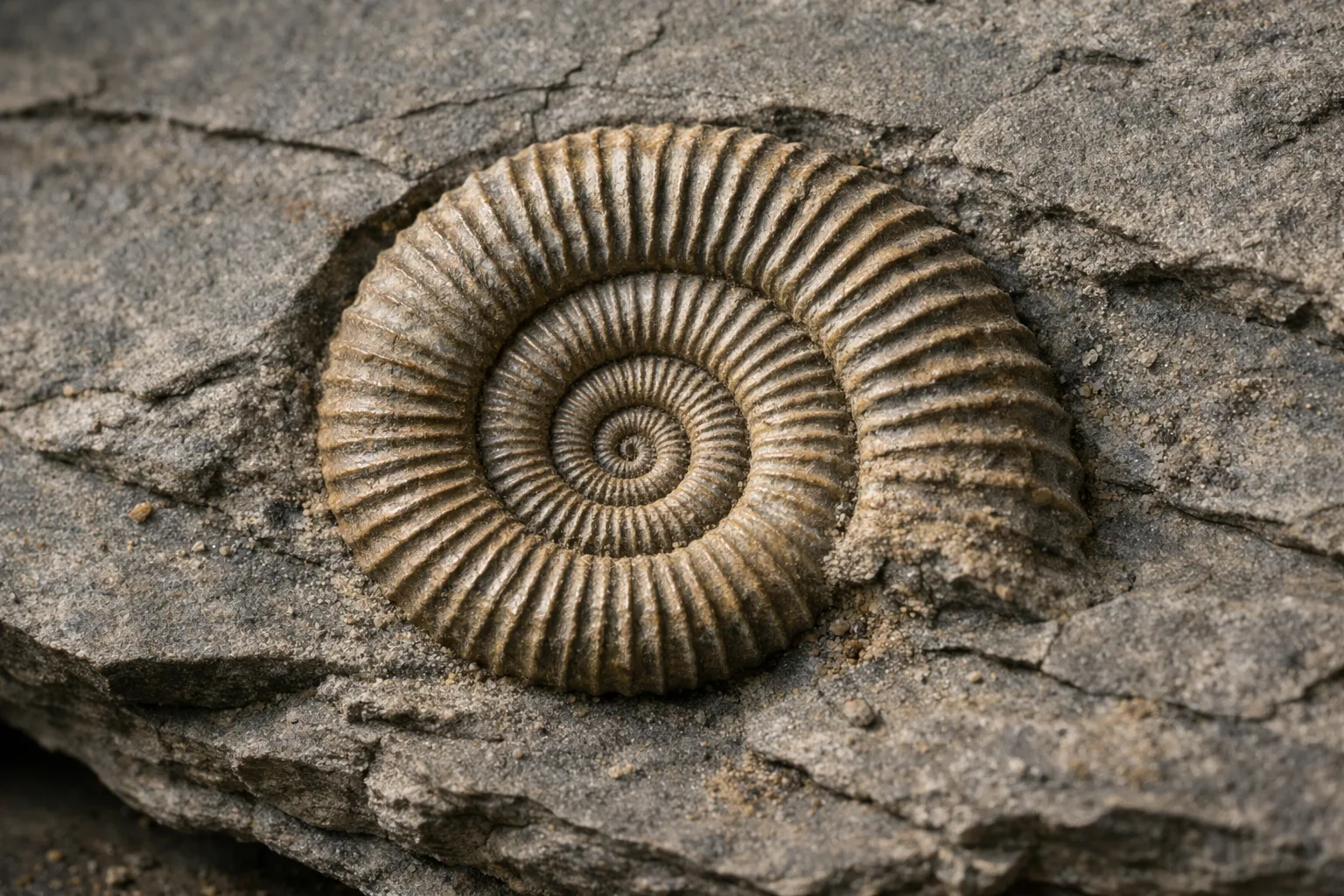
A fossil can be a dinosaur bone, a delicate leaf, a shell, or even a footprint pressed into ancient mud. What these very different objects share is a connection to life in the past—and a history of preservation that often began soon after an organism died. Fossils form when remains or traces escape the usual processes of decay and become preserved, sometimes as rock, over immense spans of time.
The process is not a simple matter of an animal dying and turning to stone. Most dead organisms decay, are eaten, or are broken apart before they can be preserved. Fossilization is unusual because it requires the right conditions, often including quick burial and the presence of minerals. The details vary, and many fossils preserve only part of an organism or a record of what it did.
First, something has to be preserved
After an organism dies, scavengers, bacteria, weather, and water can rapidly destroy its remains. Burial can help protect them. Mud, sand, volcanic ash, or other sediment may cover a body or plant before it is scattered or completely decomposed. In places where sediment builds up, more layers can accumulate above it, shielding the remains from some damage and changing the conditions around them.
Hard parts have a better chance of surviving than soft tissues. Bones, teeth, shells, and woody stems contain durable materials that can persist after softer parts have decayed. That is why the fossil record is full of shells and skeletons but offers a much less complete account of soft-bodied life. Under unusual conditions, such as rapid burial or an environment that slows decay, soft tissues can sometimes be preserved too—but this is comparatively rare.
Even burial does not guarantee a fossil. Sediment may later be eroded away, or heat and pressure deep underground may alter or destroy what was preserved. Fossils are therefore a selective record of past life, shaped by both the organisms that lived and the places where preservation was possible.
How minerals help make a fossil
A common kind of preservation happens as mineral-rich water moves through buried remains. Water can carry dissolved minerals into tiny spaces in bone, wood, or shell. As minerals are deposited, they may fill pores and strengthen the material. This process is called permineralization. Petrified wood is a familiar example: the structure of the wood can be preserved while minerals fill its spaces.
In other cases, the original material is gradually replaced by minerals. The replacement can preserve the shape and some fine details of a shell or bone, even though its original substance has changed. The exact minerals and results depend on local conditions, including the chemistry of the water and the sediment. “Turning to stone” is a useful shorthand, but it does not describe every fossil or every path to preservation.
Sometimes the organism dissolves after leaving an impression in the surrounding sediment. The hollow left behind is called a mold. If minerals or sediment later fill that space, they can form a cast that copies the organism’s shape. Shell fossils can form this way, preserving an outline even when the original shell is gone.
Fossils that preserve impressions and traces
A fossil does not have to contain any part of an organism. Leaves can leave thin impressions or carbon-rich films in fine sediment. The imprint may show a leaf’s outline and veins even if most of the original plant material has disappeared.
Tracks, burrows, and other signs of activity are called trace fossils. A footprint might be made when an animal steps into soft sediment that later hardens and is buried by more layers. For it to survive, the ground must hold the shape long enough for preservation to begin. A trace fossil can reveal movement or behavior, while a bone usually tells a different kind of story: what an organism’s body was like.
Some fossils are preserved in materials other than rock. Insects and other small organisms can become trapped in tree resin, which can harden into amber and preserve details of their bodies. Cold or oxygen-poor environments can also slow decay and preserve remains in unusual ways. These are special circumstances, but they show that fossilization does not always follow the same route.
From buried remains to exposed fossils
Once remains are buried, layers of sediment can gradually become sedimentary rock. As more material piles up, pressure compacts the lower layers, and minerals can help bind sediment grains together. Fossils may remain inside the rock through this long transformation.
Much later, geological forces can lift rock closer to the surface. Rain, wind, rivers, and glaciers wear away the rock, sometimes exposing fossils. Finding one depends on a chain of events: an organism had to leave a preservable remain or trace, conditions had to protect it, and the rock containing it had to become accessible without being completely destroyed.
This is one reason fossils are not distributed evenly around the world. Some rocks formed in environments where burial was more likely; other rocks have been altered or worn away. The fossils scientists find are valuable evidence, but they are not a complete catalogue of every species or ecosystem that ever existed.
What fossils can—and cannot—tell us
Fossils help scientists study how organisms changed through time, what ancient environments were like, and how living things interacted with their surroundings. Shells and plant fossils can provide clues about the conditions in which sediment formed. Trackways can preserve evidence of movement. A fossil’s position in a sequence of rock layers can also help place it in Earth’s geological history.
But each fossil records only part of a larger story. A single footprint does not reveal everything about the animal that made it, and a preserved skeleton may not show the soft tissues or behavior that were lost. Scientists build stronger explanations by comparing fossils with one another and with evidence from rocks, modern organisms, and other sources.
The next time you see a fossil, consider the two stories it carries. One belongs to the living thing—or the activity—that left the mark. The other is the story of preservation: burial, chemistry, geological change, and eventual exposure. A fossil is not simply an ancient object. It is a rare message from the past that survived a long series of chances.
You might also like
How Caves Form: The Slow Work That Shapes Rock
Caves form as water dissolves rock, waves carve coastlines, or lava drains from cooling flows. Discover how tiny cracks grow into underground passages.
How Geodes Grow Their Crystal-Filled Interiors
A geode starts with a hidden cavity in rock. Mineral-rich water slowly deposits crystals along its walls, turning an ordinary-looking stone into a geological treasure.
How Do Mushrooms Seem to Appear Overnight?
Mushrooms don’t grow from nothing in a single night. Their hidden fungal network can produce visible fruiting bodies quickly when conditions are right.