Can Scientists Know What Dinosaurs Sounded Like?
By WowPebble Editorial
Fossils can reveal clues about dinosaur hearing and sound-making anatomy, but no one can recover a prehistoric roar. Here is what scientists can—and cannot—know.
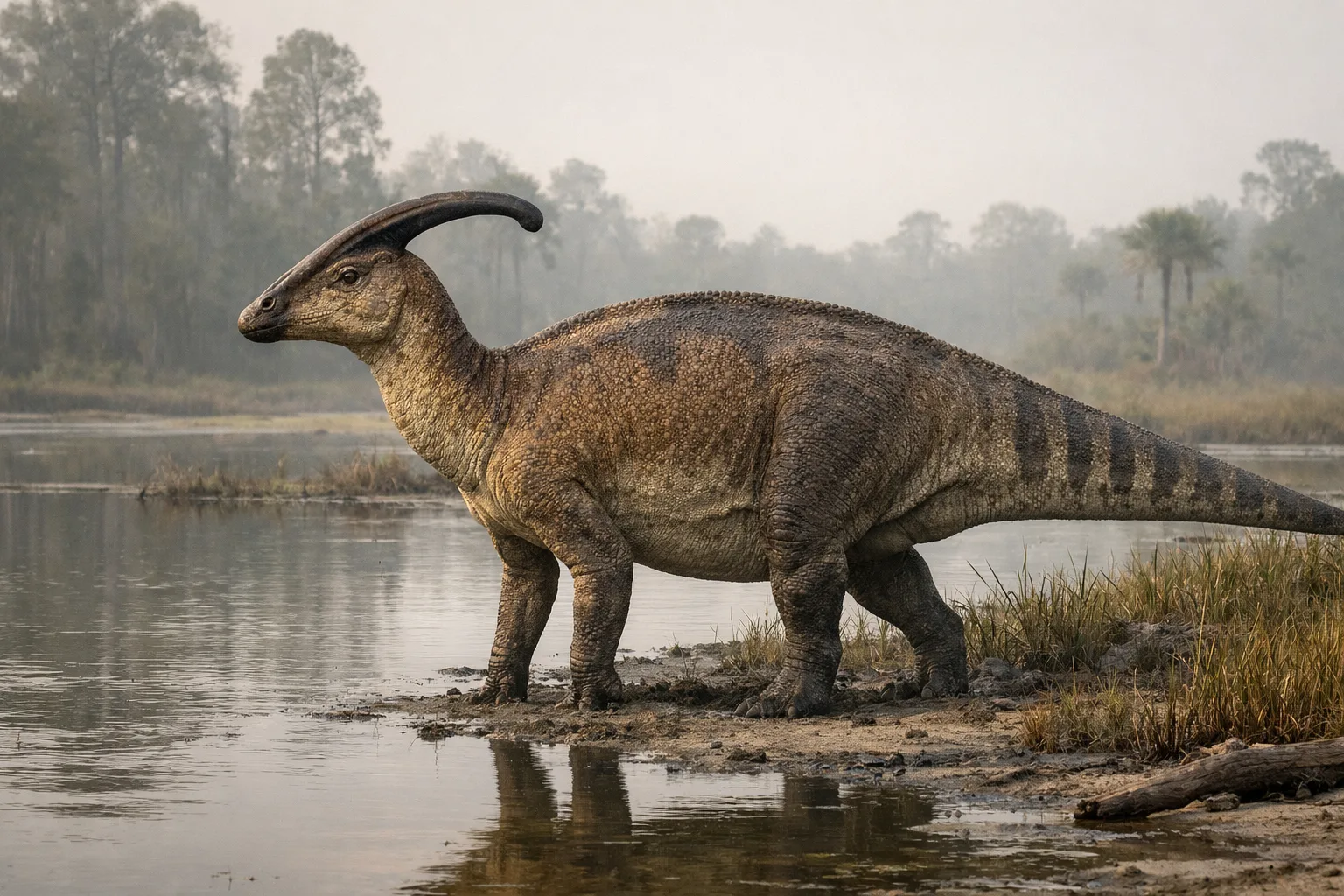
A dinosaur’s roar can feel real on screen, but no fossil can tell us exactly what a living animal sounded like. Sound does not usually leave a trace in stone. Scientists can still investigate the question, though: bones, preserved anatomy, and comparisons with living animals offer clues about how some dinosaurs might have made or heard sounds. The result is a range of informed possibilities, not a recording of the past.
Why there is no simple answer
Sound is produced by soft tissues and moving air, not by bones alone. In living animals, vocal organs, throat structures, air sacs, and other tissues shape the sound. Those parts rarely fossilize. Even when a skeleton is remarkably complete, it usually cannot reveal the exact size, tension, or movement of the tissues that produced a call.
And “dinosaur sound” is not one sound. Dinosaurs included animals with different sizes, bodies, and ways of life. They may have communicated in more than one way, and their calls could have varied by species, age, or situation. A huge animal might not necessarily have made the deep, thunderous roar that films have trained us to expect.
What fossils can tell us
Fossils preserve hard parts best, but those parts can still provide useful evidence. The shape of a skull, the arrangement of air passages, and the structure of the inner ear can help researchers ask questions about sound. In some cases, scans of fossil bones make it possible to examine internal spaces without damaging the specimen.
A documented example is Sandia and the New Mexico museum’s 1997 project using CT scans of a Parasaurolophus crest to build a computer sound model. This is a reconstruction based on the fossil and modelling choices, not a recording of the animal. It helps investigate possible resonance without proving the exact call or its behaviour in life.
A resonant chamber is not a preserved voice. Its shape may help indicate which frequencies could have been amplified, much as the shape of an instrument affects its sound. But the final result would also depend on soft tissues, airflow, posture, and behavior—details that a fossil model cannot fully supply.
Clues from living relatives
Scientists also compare dinosaurs with animals alive today. Birds are living dinosaurs, while crocodilians are their closest living relatives outside the dinosaur group. Both offer valuable comparisons, but neither is a perfect stand-in for a long-extinct species.
A concrete comparison is the fossil bird Vegavis. The research team’s University of Texas account describes a preserved syrinx, the organ at the lower end of a bird’s windpipe. Crocodilians use a laryngeal vocal apparatus instead. This supports a distinction between mechanisms; it does not establish that every non-avian dinosaur lacked a syrinx, or give an exact recording of Vegavis.
Comparisons can help researchers consider what is biologically possible. They cannot establish that a particular dinosaur had a birdlike song or a crocodile-like bellow. Evolution changes anatomy over time, and the relevant soft parts are usually missing from the fossil record.
Hearing is a separate question
Inner-ear anatomy offers clues about hearing, but the inference has limits. A 2025 re-analysis by auditory researchers Manley and Köppl cautions that one bony measurement cannot establish a dinosaur’s precise hearing abilities or behaviour. Comparisons with living species need appropriate anatomy and measurements; a fossil’s cochlear shape alone is not an audiogram.
That distinction matters. Evidence about hearing might suggest that an animal could detect certain sounds, but it does not prove that the animal made those sounds itself. Nor does it reveal whether a call was used to warn others, attract a mate, keep a group together, or serve another purpose. Behavior rarely fossilizes along with the bones.
Why movie dinosaurs roar
Films need sounds that audiences can recognize and respond to. Designers build prehistoric soundtracks from recordings, instruments, and altered animal noises, combining them into something dramatic and legible. Those effects can be memorable, but they are creative interpretations rather than scientific reconstructions.
The familiar image of a dinosaur roaring like a large mammal is especially difficult to justify from fossils alone. Some dinosaurs may have made deep calls; others may have produced sounds that were higher, quieter, or less like a conventional roar. Some communication might also have involved visual displays or other behaviors rather than vocal calls. Without direct evidence, confidence should stay limited.
So, what can scientists know?
Scientists can investigate which structures might have shaped sound, estimate some acoustic properties, and compare dinosaurs with living animals. They can sometimes make cautious suggestions about hearing. What they cannot do is reconstruct an exact voice from a skeleton or know for sure what a dinosaur’s calls meant.
That does not make the question unscientific. It means the answer comes in layers: strong evidence for what a fossil’s anatomy was like, more tentative estimates of how it functioned, and much greater uncertainty about the sounds and behavior of a living animal. The next time a dinosaur roars on screen, it is worth hearing it as an imaginative possibility—not a sound recovered from the past.
You might also like

How Do Mushrooms Seem to Appear Overnight?
Mushrooms don’t grow from nothing in a single night. Their hidden fungal network can produce visible fruiting bodies quickly when conditions are right.

How Tidal Bores Send Waves Upstream
A tidal bore forms when a rising tide is funneled into a shallow river mouth, steepening into a moving front that can surge against the river’s flow.
Why Chameleons Change Color—and What the Colors Signal
Chameleons change color to communicate, respond to temperature and light, and sometimes blend in. Their shifting shades come from both pigments and remarkable skin cells.