Why Sidewalks Have Raised Bumps Near Crossings
By WowPebble Editorial
Those raised sidewalk bumps are tactile warnings. They help blind and low-vision pedestrians detect where a sidewalk ramp meets the roadway.
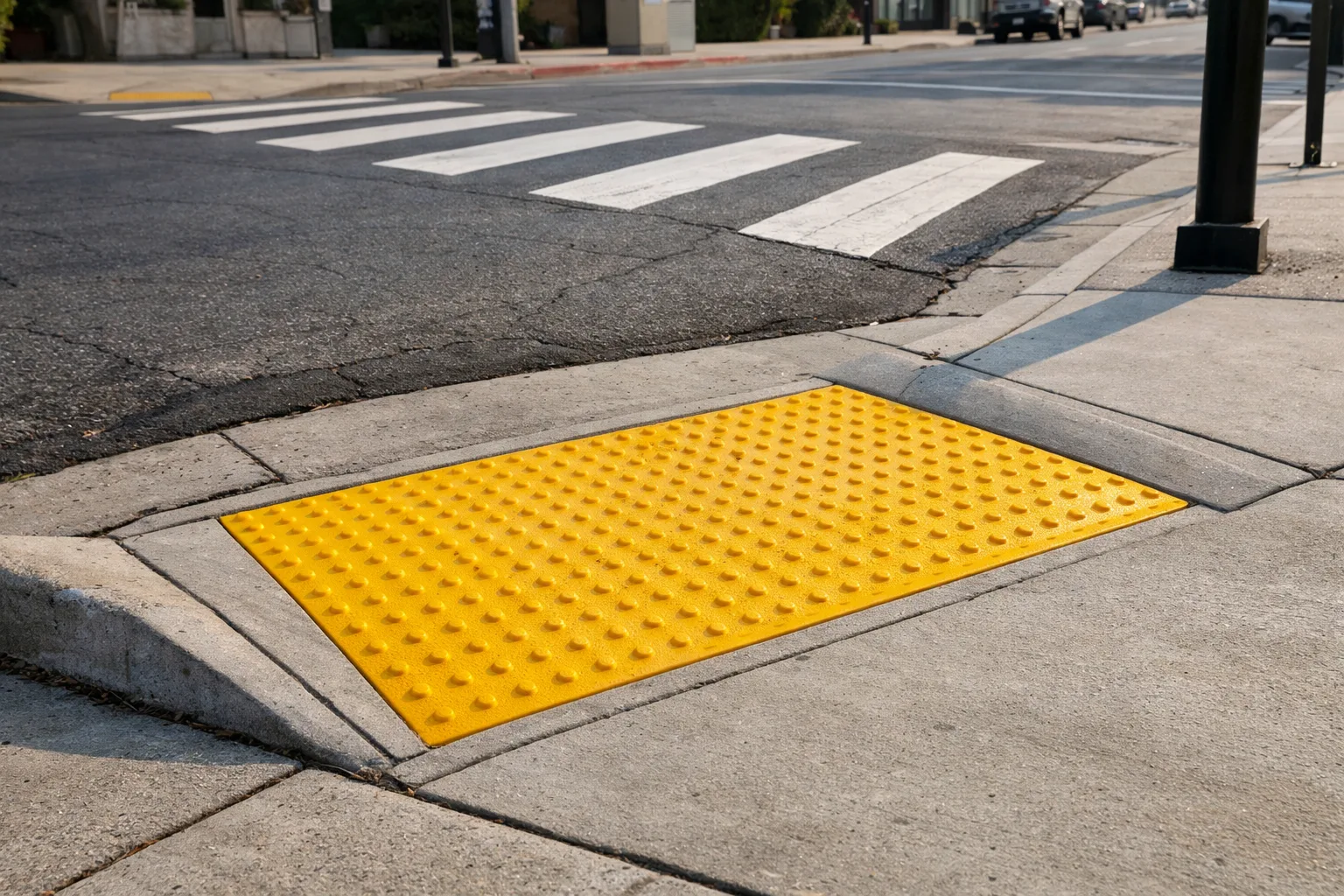
The raised bumps near many crossings are tactile warning surfaces. They help blind and low-vision pedestrians recognize that they are approaching the edge of a sidewalk and a roadway. The bumps can be felt underfoot or detected with a cane, and their contrasting color can make them easier to see.
Why a smooth ramp needs a distinct warning
A curb ramp or a crossing raised to sidewalk level can remove the obvious step between a pedestrian route and a road. The warning surface adds a detectable change where that level difference is absent or reduced. Its purpose is to identify a boundary, rather than to decorate the pavement.
In the United States, the Access Board’s public right-of-way guidelines specify a pattern of truncated domes—raised shapes with flat tops—for detectable warnings. They also require contrast with the adjacent walking surface. Contrast can be light against dark or dark against light; the rule is not simply “all warning tiles must be yellow.” The guidelines describe placement at curb ramps and other defined transitions, not a universal pattern for every textured surface worldwide.
Warning bumps and guidance surfaces have different jobs
It is easy to call all textured paving a guide, but that hides an important distinction. A warning surface alerts a person to a transition or hazard. A guidance surface has a different function in helping identify a route.
Active Travel England distinguishes six tactile surface types, including blister paving at crossing points and a separate guidance-path surface. Other types address platforms, hazards or shared pedestrian and cycle spaces. That is why an unfamiliar pattern should not be interpreted solely by its color or by the fact that it feels bumpy. Its shape, layout and local system matter.
What the paving does not tell you
Static paving does not change when traffic starts moving. It cannot tell someone that a driver has stopped or that a walk phase is active. Crossing still involves the appropriate signals and traffic checks; the Highway Code’s pedestrian guidance treats those as separate decisions.
This explanation describes the purpose of the surfaces, not a route-specific crossing instruction or a substitute for orientation and mobility training. It also explains why consistent installation and maintenance matter: a warning must remain recognizable in the local system to do its job.
You might also like
Why Do Some Bridges Have Gaps Between Their Sections?
Those bumps and seams on a bridge have a job: they let the structure move safely as temperatures change, traffic passes, and materials slowly shift.

Why Do Mirrors Reverse Left and Right but Not Up and Down?
A mirror does not actually swap left and right. It reverses the direction pointing into the glass—and the way we compare ourselves with the reflection creates the illusion.
Why Does a Retractable Pen Click When You Press It?
A retractable pen’s click comes from a small locking mechanism inside its barrel. Here’s how the button, cam and spring work together to extend and retract the tip.