Why Shoelaces Have Plastic Tips—and What Aglets Actually Do
By WowPebble Editorial
Those small plastic caps on shoelaces have a name: aglets. They stop lace ends from fraying and make threading them through eyelets much easier.
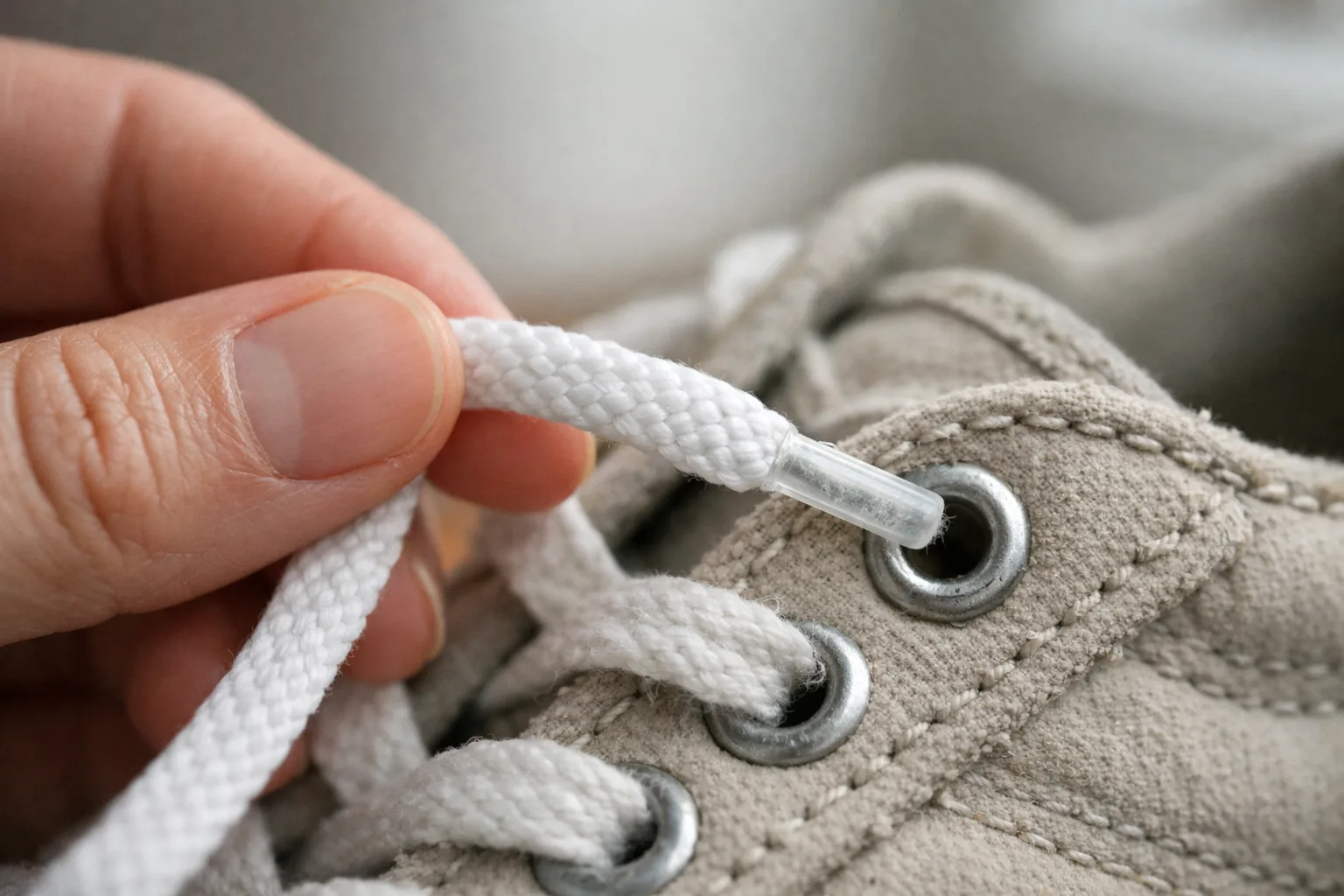
The little plastic tips on shoelaces do a useful job: they keep the lace from unraveling and help it slip through the small holes in a shoe. Without them, a lace’s woven fibers can separate, leaving a soft, frayed end that is harder to thread and tie. Those tips have a name, too: they are called aglets.
An aglet is the small covering or binding at a lace or cord end. Lace Lab’s aglet guide describes both plastic and metal versions and their roles in fray control and threading. Their exact manufacture and attachment differ; a plastic-looking tip is not evidence of one universal moulding process.
How an aglet makes lacing easier
In a woven or braided textile lace, many fibres make a flexible length that can bend around the shoe. At a cut end those fibres can loosen under repeated handling. That explains the common textile case; a leather lace or a differently finished cord need not share the same construction.
An aglet gathers those fibers into a compact end. It also gives the lace a firmer shape. That matters when you are threading it through a shoe’s eyelets: a narrow, slightly stiff tip is easier to guide than a floppy bundle of loose fibers. Once the lace has passed through, the aglet helps keep the end intact for the next time you lace up.
Its shape is useful throughout the lacing process. You can hold the tip between your fingers, aim it at an eyelet, and push it through without having the fibers spread apart. This makes the lace easier to handle when you are putting it through several eyelets or relacing a shoe. The aglet does not change how the lace ties; it makes the loose end easier to control.
The tip does not make a lace impossible to damage. A worn or cracked aglet can split, and a lace can still fray if its end is badly damaged. But an intact one helps a lace stay practical through the repeated handling that shoes require.
Why are they usually plastic?
A compact plastic finish can contain the lace end while presenting a smoother, firmer shape to the eyelet. Its precise forming process depends on the product. Do not infer an injection-moulded sleeve, a particular polymer or a measured production cost simply from the tip's appearance.
Not every aglet is plastic. Metal tips are used on some laces and cords, and some lace ends are finished with other materials or techniques. The best choice depends on the item’s design and use. A plastic tip is common on casual shoelaces because it provides a simple, unobtrusive finish; metal can offer a different look or feel.
Aglets are sometimes treated as decoration, but their usefulness is easy to notice when one breaks. The lace end begins to spread, and threading it through eyelets becomes a small but irritating chore. A broken tip can also leave the loose fibers difficult to grasp neatly. The little cap is doing practical work, even when it barely attracts attention.
A small tip with a practical role
The flexible lace and its firmer end do different jobs. The lace bends around the shoe; the finished tip gives you a smaller, more manageable end to pass through an eyelet.
Look at the tip as well as the lace when threading becomes difficult. A split or frayed end may no longer fit cleanly even when the rest of the lace is intact. Do not force a damaged metal tip through an eyelet or assume every replacement end fits the same lace.
What happens when an aglet wears out?
A damaged aglet is often easy to spot. It may be cracked, split, loose, or missing altogether. The lace end may start to look fuzzy as its fibers separate. If the tip is still attached but damaged, it may no longer guide the lace smoothly through an eyelet. The problem is usually with the finish at the end, rather than with the basic way the lace works.
If an end is damaged, first check whether the lace itself remains sound and whether a suitable replacement tip exists. A replacement must follow its own fitting instructions and fit through the eyelets without forcing. A makeshift wrap does not restore worn fibres or certify that a loose cap will remain attached.
A replacement aglet is another option. Some are designed to fit over a cut lace end and can be secured in place. The important thing is to make the finished tip narrow enough to pass through the eyelets without being so loose that it slips off. If the lace itself is badly frayed or worn, replacing the whole lace may be more reliable. A temporary wrap can help with threading, but it does not restore worn fibers along the length of the lace.
A small part with a practical purpose
The plastic cap at the end of a shoelace is not merely a finishing flourish. An aglet protects the woven end of a lace, gives it a shape that is easier to handle, and makes threading and tying shoes more dependable. Its design is simple: contain the fibers and leave a firm, narrow tip that can pass through an opening.
That same straightforward function explains why the part appears on different kinds of cords, and why its materials and appearance can vary. Whether it is plastic, metal, or another finish, an aglet keeps a cord end tidy and usable. It is a tiny part with an everyday job—and one you notice most when it stops doing that job.
You might also like

Why Do Mirrors Reverse Left and Right but Not Up and Down?
A mirror does not actually swap left and right. It reverses the direction pointing into the glass—and the way we compare ourselves with the reflection creates the illusion.
Why Does a Retractable Pen Click When You Press It?
A retractable pen’s click comes from a small locking mechanism inside its barrel. Here’s how the button, cam and spring work together to extend and retract the tip.

Why Do Chimneys Have Caps? The Practical Reasons Explained
Chimney caps keep out rain, animals and debris, and some help contain sparks or reduce wind-driven downdrafts. Here’s how they work—and what they don’t do.