Why Road Signs Use Shapes as Well as Colors
By WowPebble Editorial
Road sign shapes do more than make roads look organized: they offer a quick visual clue when color is hard to see or there’s little time to react.
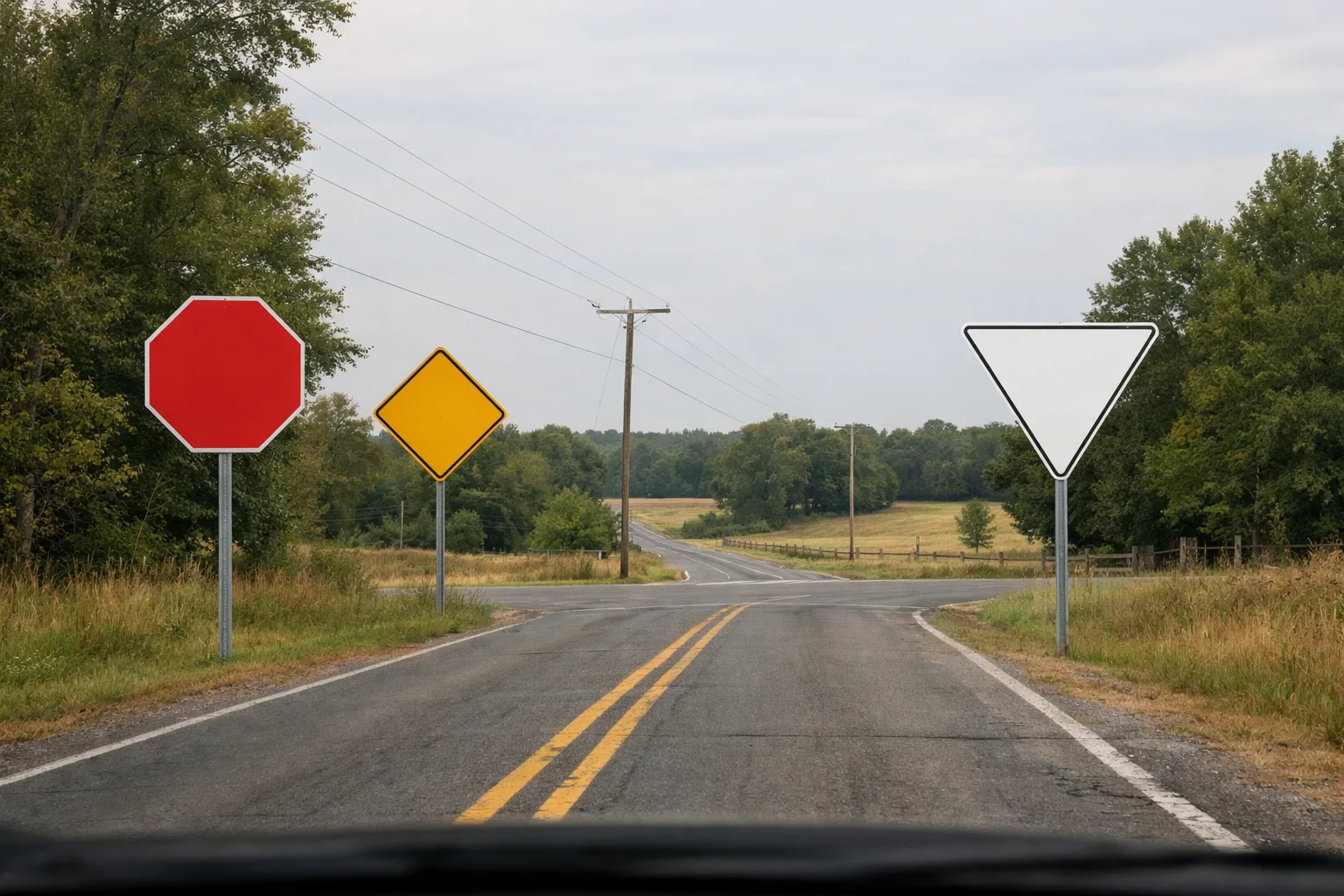
A road sign has only a moment to catch your attention. You might see it in rain, at night, through a dirty windshield, or from the corner of your eye. That is why signs use shapes as well as colors: each visual cue adds another chance to recognize what a sign means, even when another cue is difficult to make out.
Color and shape work together like a simple visual code. Red can signal a restriction or a need to stop, while an octagon or triangle can help identify a sign’s role before you can read its words or symbols. The exact meanings vary between countries, but the underlying idea is practical: make important signs easier to notice and distinguish quickly.
Shape is a backup signal
Color is useful, but it is not always reliable. Darkness, glare, fog, rain, dirt, aging materials, or a blocked view can make a sign’s color hard to distinguish. A driver may also see a sign only briefly, without looking straight at it.
Shape gives the eye another clue. The brain can often recognize a broad outline quickly, even when small details are unclear. A distinctive silhouette may therefore help a driver identify a sign category before getting close enough to read a message. This is not a substitute for seeing the sign clearly; it is an extra layer of information.
The principle is similar to using both a symbol and a label on a button. If one clue is missed, the other may still help. Road signs combine shape with color, symbols, words, borders, and placement so that their meaning does not depend on just one feature.
Familiar shapes can signal familiar actions
Some sign shapes are especially recognizable. In the United States and many other places, a stop sign is an octagon. A yield sign is an inverted triangle. Their outlines help distinguish them from ordinary rectangular signs, including when a driver is approaching from an angle or seeing the sign at a distance.
The octagonal stop sign offers a further practical advantage: its outline can be recognized from behind. A driver coming from the opposite direction may see the back of the sign and infer that cross traffic has a stop sign, even though they cannot read its front. The shape is not a complete description of the intersection, but it can provide a useful clue.
Yield signs use a downward-pointing triangle in many countries. That unusual orientation helps set them apart from other signs. In the United States, warning signs commonly use a diamond shape. Elsewhere, triangular warning signs are common. These examples show why it is important not to assume that every shape means exactly the same thing everywhere.
Railway crossings offer another recognizable form: the crossbuck, an X-shaped sign used in some countries. Its shape refers to the crossing itself and is quite different from the standard outline of many road signs. As with other signs, local rules determine exactly how it is used.
Why not use color alone?
Color can communicate quickly, but it has limitations. It can be altered by lighting and weather, and some people have difficulty distinguishing certain colors. A sign partly hidden by a vehicle, branch, or snowbank may also reveal its shape while concealing much of its face.
Using more than one visual feature makes the system more robust. If the red on a stop sign is hard to see, its octagonal outline may still be noticeable. If a driver does not immediately recognize a shape, color, a familiar symbol, or a short word may help instead. The cues reinforce one another rather than asking the driver to rely on a single detail.
This does not mean shapes solve every visibility problem. A sign can still be obscured, damaged, poorly placed, or missed altogether. Shape is one part of a broader approach to making signs legible and predictable.
Standardization makes shapes useful
A shape only helps if drivers know what to expect from it. That is why traffic authorities use standards to make sign designs consistent within a region. When a driver encounters a familiar outline again and again, recognition can become quicker and more automatic.
Road-sign systems developed in different places, so the same shape does not have a universal meaning. One country may use a diamond for warnings while another uses a triangle. Colors, symbols, and the way signs are positioned can also differ. International agreements and national rules help create consistency, but they do not make every country’s signs identical.
For travelers, this is a reason to learn local road rules rather than relying on shape alone. A useful general habit is to treat a distinctive sign as a prompt to pay attention, then read its symbol or wording and follow the rules that apply where you are driving.
Why signs do not all have unique shapes
It might seem safest to give every message its own shape. In practice, that would make the system harder to learn and harder to maintain. Drivers would have to memorize a much larger collection of outlines, and new or uncommon signs might be difficult to recognize.
Instead, many systems group signs by purpose. A limited set of shapes can help distinguish broad categories, while color, symbols, words, borders, and context provide more specific information. That balance makes signs easier to recognize without requiring a unique silhouette for every possible instruction or hazard.
Shapes also have to work in the physical world. Signs need to be manufactured, installed, and replaced, and their outlines must remain reasonably clear at a distance. Standard designs help road authorities manage that work and help drivers encounter familiar patterns from one road to another.
A small design choice with a practical purpose
Road-sign shapes are not decoration. They are part of a layered system designed for quick recognition, changing conditions, and human limits. Color may catch your eye; shape can confirm what kind of message you are seeing; words or symbols can tell you the detail.
The next time you notice an octagon, an inverted triangle, or a diamond beside the road, think of it as a clue delivered before you have time to read. It is one of several pieces of information designed to reach you quickly—and, when another piece is hard to see, to give you a second chance.
You might also like
Why Traffic Lights Use Red, Yellow, and Green
Red, yellow, and green were chosen for a mix of history, visibility, and practicality. Here’s how the familiar traffic signal system took shape.

Why Do Mirrors Reverse Left and Right but Not Up and Down?
A mirror does not actually swap left and right. It reverses the direction pointing into the glass—and the way we compare ourselves with the reflection creates the illusion.
Why Does a Retractable Pen Click When You Press It?
A retractable pen’s click comes from a small locking mechanism inside its barrel. Here’s how the button, cam and spring work together to extend and retract the tip.