Why Your Rearview Mirror Has a Nighttime Setting
By WowPebble Editorial
A rearview mirror’s night setting redirects the strongest reflection of headlights away from your eyes, leaving a dimmer view that helps reduce glare.
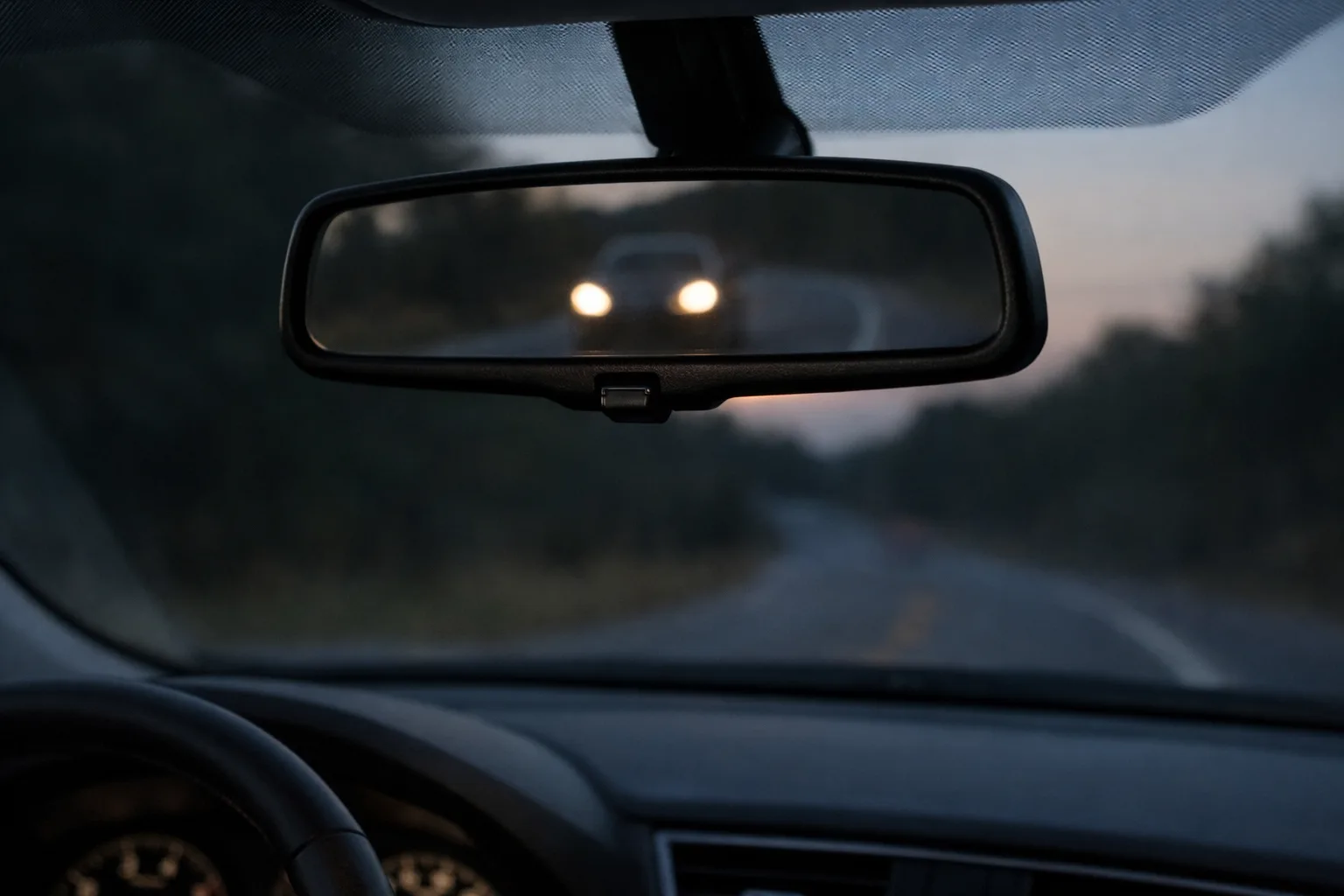
A rearview mirror’s nighttime setting reduces glare by changing the mirror’s angle. In a manual mirror, flipping the small tab tilts the glass so the strong reflection of headlights is directed away from your eyes. You can still see traffic behind you, but the image is dimmer.
How the manual setting works
A typical manual day-and-night mirror uses a wedge-shaped piece of glass with a reflective coating on its back. In the daytime position, light from behind passes through the glass, reflects off the coating and returns to your eyes as a clear, bright image. A small amount of light also reflects from the glass’s front surface, but that reflection is usually too faint to notice.
When you flip the tab, the mirror changes angle. The strong reflection from the rear coating is sent away from your eyes, while the faint reflection from the front surface remains visible. That weaker image is why the road behind you looks darker in the night setting. The mirror hasn’t blocked the headlights; it has changed which reflection reaches you.
The tab’s direction varies between mirrors, so look for the position that visibly dims the reflection. You’re changing the mirror’s day-or-night angle, not aiming it at a different part of the road. If the view becomes too dark to see traffic clearly, switch back to the brighter setting and adjust your driving accordingly.
Why dimming helps—and what it can’t do
Headlights behind you can be uncomfortable or distracting, especially when they shine directly into the mirror. Reducing their reflected brightness can make it easier to keep your attention on the road ahead. The trade-off is that other objects in the mirror become harder to see, too. The night setting is meant to soften glare, not provide a brighter or clearer view in darkness.
It also doesn’t change the brightness of the headlights themselves or eliminate glare from other directions, such as headlights reflected in the side mirrors. If the mirror is still dazzling, check that it is set to the night position and that its aim is correct for your normal driving view. Make any adjustments while the vehicle is stopped, before you start driving.
Some mirrors dim automatically
Many vehicles have an auto-dimming rearview mirror instead of, or alongside, a manual tab. These mirrors use sensors to detect light from behind and electronically darken the reflective surface when needed. The effect is similar—less headlight glare, with a dimmer view behind—but there is no tab to flip. The exact controls and operation vary by vehicle.
Whether the dimming is manual or automatic, the purpose is the same: make bright reflections less bothersome while keeping a view of the road behind you.
You might also like

Why Do Mirrors Reverse Left and Right but Not Up and Down?
A mirror does not actually swap left and right. It reverses the direction pointing into the glass—and the way we compare ourselves with the reflection creates the illusion.
Why Does a Retractable Pen Click When You Press It?
A retractable pen’s click comes from a small locking mechanism inside its barrel. Here’s how the button, cam and spring work together to extend and retract the tip.
Why Do Chimneys Have Caps? The Practical Reasons Explained
Chimney caps keep out rain, animals and debris, and some help contain sparks or reduce wind-driven downdrafts. Here’s how they work—and what they don’t do.