Why Do Power Lines Have Bright Balls Attached? The Safety Reason Behind Them
By WowPebble Editorial
Those colorful spheres on overhead wires are more than an odd roadside sight. They help pilots spot hard-to-see cables before getting too close.
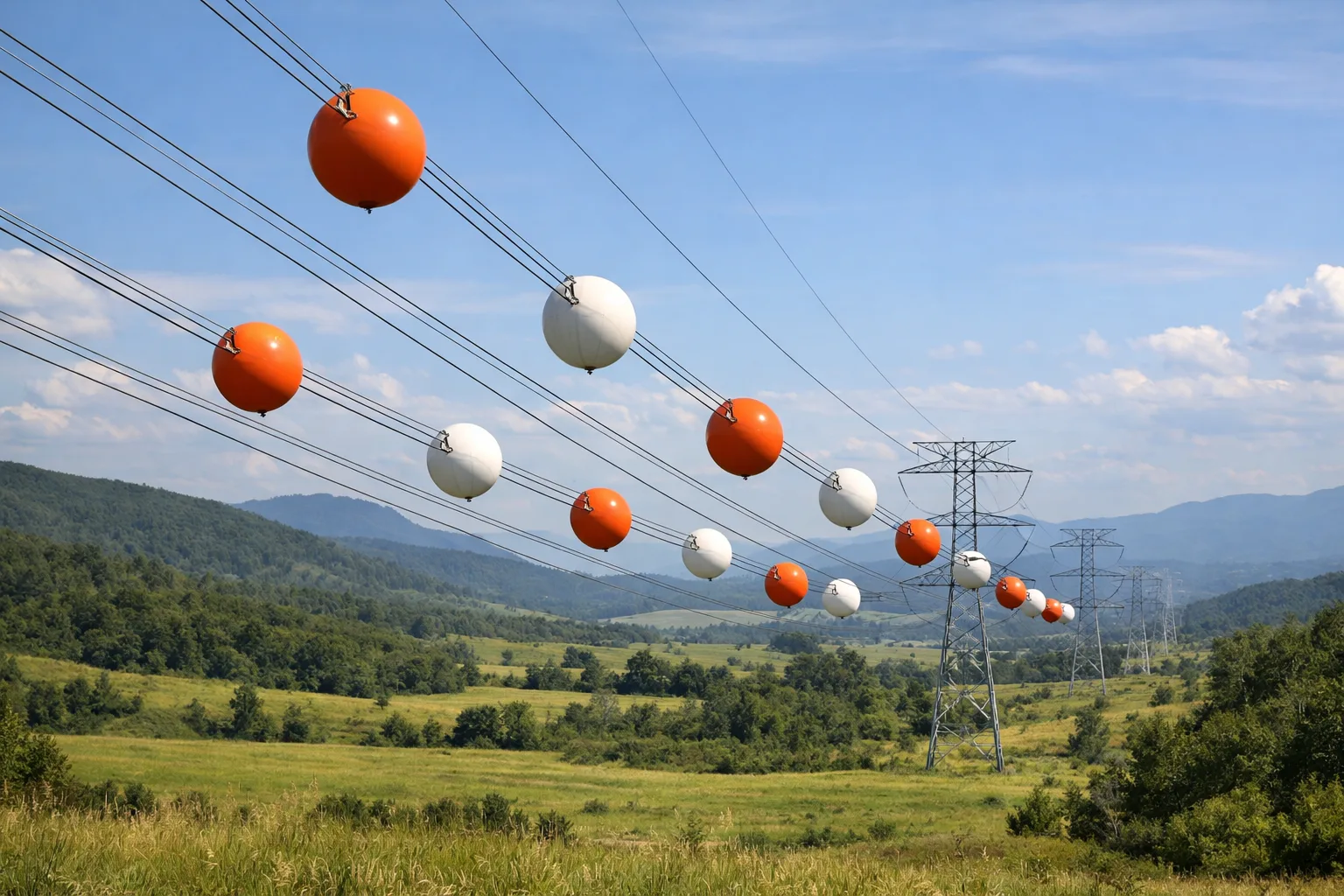
The bright balls are warnings for aircraft
The colorful spheres attached to some power lines are aerial marker balls. Their job is to make overhead cables easier for pilots to see, especially when an aircraft is flying low. A wire can be difficult to pick out against the sky or landscape, even when the towers holding it are obvious. The bright markers make the cable’s location much easier to notice in time to avoid it.
That matters because overhead lines can cross places where aircraft may fly close to the ground, such as broad valleys, river corridors, and areas near airports or helicopter routes. The towers are large and visible, but the wire stretched between them may be thin, distant, and nearly invisible from a cockpit. A row of bright spheres gives pilots a conspicuous clue that a cable is there.
What the markers do—and what they don’t
The balls are visual warnings, not electrical equipment. They do not power the line, insulate it, or stop it from carrying electricity. Nor are they designed to protect the cable from lightning. They simply help people in the air see wires that could otherwise blend into their surroundings.
They may be placed on power lines and other overhead cables where visibility is especially important. Depending on the installation, markers are attached to selected cables across a span—the section between supporting structures. They are often positioned on a high cable so they can be seen clearly, though the exact arrangement depends on the site and the line.
Not every power line has them. Many wires are in places where aircraft are unlikely to fly close, or where other safety measures and local requirements apply. Markers are most useful where a cable crosses an open area or could be hard for a pilot to detect. Their absence does not mean a wire is safe to approach: all overhead lines should be treated as potential hazards.
Why make them spherical and brightly colored?
A sphere is visible from many directions, so a pilot does not have to see a particular face of the marker. It also does not need to hang in a specific orientation to work. Bright colors—often orange, red, yellow, or white—help the markers stand out against changing backgrounds. A color that contrasts with the sky may be less noticeable against land, so installations can use more than one color to improve visibility across different views.
The markers need to remain visible outdoors through wind and changing weather. They are made with durable, lightweight materials and secured to the cable, rather than acting as loose objects that could swing freely. Their size and placement are chosen to make the line easier to spot while fitting the conditions of the particular crossing.
From the ground, the spacing can look almost decorative, like oversized beads strung across the sky. But the layout is intended to make the cable itself easier to recognize. The markers do not form a barrier or guide aircraft along a route; they signal that an obstacle is present.
Why are they found in some places and not others?
A cable becomes a greater concern when it crosses a route where low-flying aircraft might pass, or when the surrounding terrain makes it hard to see. A line over a river, canyon, or open valley can be especially challenging: the cable may be silhouetted against the landscape, while its supports are far apart. Near airfields, pilots may also be climbing, descending, or maneuvering at lower altitudes.
Local aviation and utility rules can influence where markers are needed and how they are installed. The details vary by location and site. A utility may also use other forms of visibility marking where appropriate. The basic principle is the same: help pilots recognize a wire before they reach it.
Are they for birds or for people on the ground?
Their main purpose is to warn aircraft, not to decorate the line or make it safer to touch. Some devices attached to wires are designed to help birds detect cables, and those may look different or serve a separate purpose. A bright ball may be visible to birds too, but that does not change why aerial marker balls are installed.
They are not a warning for people who might walk beneath a line, either. The spheres do not make the wires harmless, and they do not indicate that a cable is unpowered. Power lines can be dangerous even without direct contact, so it is important to keep a safe distance and never approach a downed wire.
A small marker for a hard-to-see hazard
The spheres are easy to notice because they look unusual, but the problem they address is simple: a long, narrow wire can vanish against its surroundings. By giving pilots bright, repeated points to look for, marker balls make an otherwise subtle obstacle more visible from the air.
So the next time you spot a string of orange or white balls on a power line, you are seeing a practical safety measure. They are there to help an aircraft notice the wire—not to change how the electricity works.
You might also like

Why Do Mirrors Reverse Left and Right but Not Up and Down?
A mirror does not actually swap left and right. It reverses the direction pointing into the glass—and the way we compare ourselves with the reflection creates the illusion.
Why Does a Retractable Pen Click When You Press It?
A retractable pen’s click comes from a small locking mechanism inside its barrel. Here’s how the button, cam and spring work together to extend and retract the tip.
Why Do Chimneys Have Caps? The Practical Reasons Explained
Chimney caps keep out rain, animals and debris, and some help contain sparks or reduce wind-driven downdrafts. Here’s how they work—and what they don’t do.