Why Paper Towels Have Embossed Patterns—and What They Actually Do
By WowPebble Editorial
Those dots, diamonds, and waves are more than decoration. Embossing can help paper towels feel thicker, hold together, and manage spills.
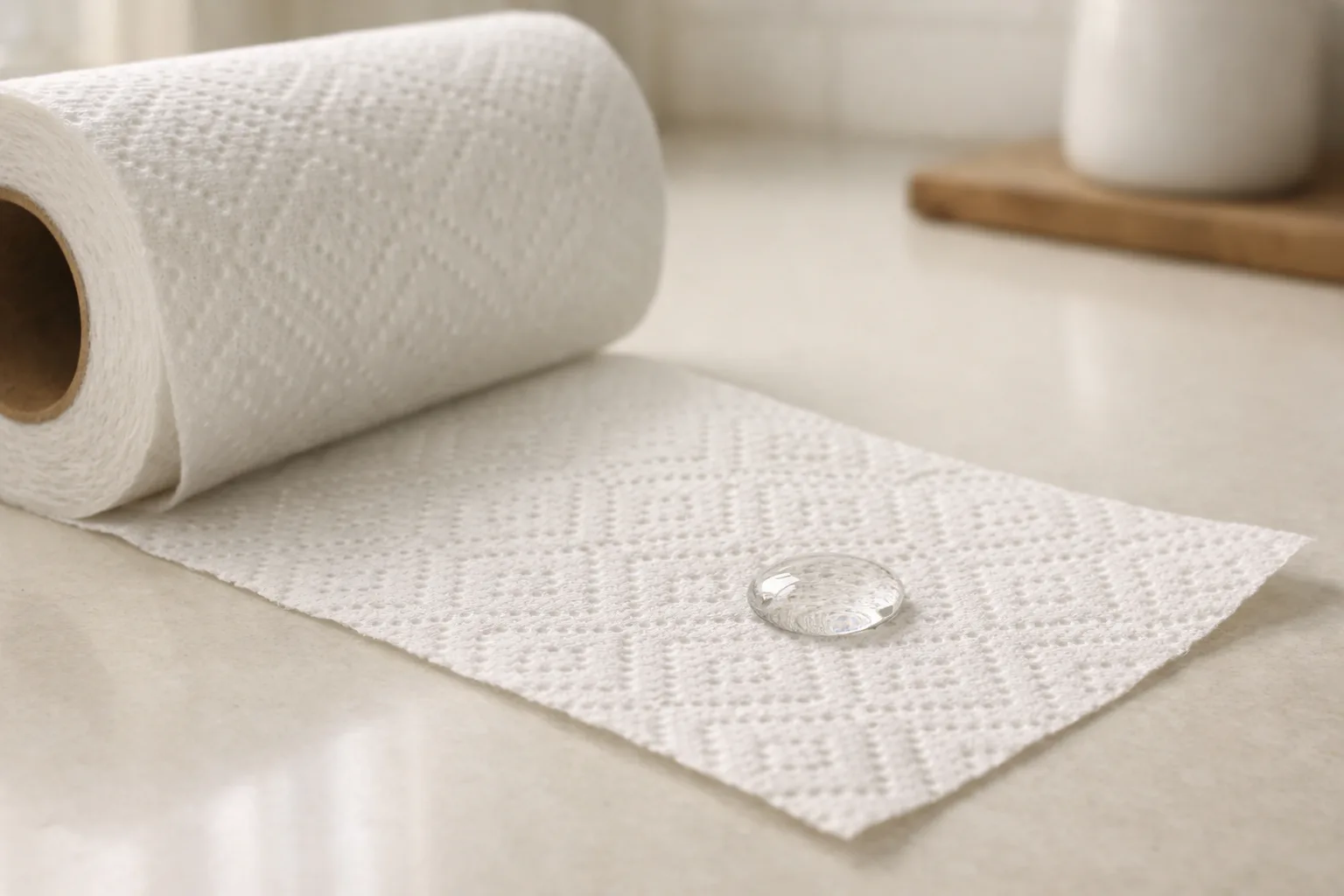
Look closely at a paper towel and you’ll often find a pattern of dots, diamonds, waves, or tiny ridges pressed into its surface. These marks aren’t just decoration. Embossing changes the towel’s texture and structure, helping give it loft, helping its layers hold together, and creating a surface that can manage spills. The pattern can matter—but the paper’s fibers do most of the absorbing.
What embossing does
Embossing is a way of pressing a design into paper. During production, rollers impress a pattern into the paper towel, leaving some areas raised and others comparatively flat. The exact process varies: a towel may be made from one layer, or from multiple plies that are embossed together.
In a multi-ply towel, embossing can help connect the layers at points across the sheet. This helps the plies act more like one piece instead of sliding around independently. The pattern also adds texture and can make the sheet feel thicker or more substantial than a smooth sheet of similar weight.
That extra sense of thickness is often called loft. The raised areas and spaces between them give the sheet a less flat, more cushioned structure. It’s one reason an embossed towel can feel soft or puffy in the hand, even before it gets wet.
How the pattern helps with spills
Paper towels absorb liquid through their network of cellulose fibers. Water is drawn into the tiny spaces between those fibers by capillary action—the same basic process that lets liquid move through a narrow gap. The embossed pattern doesn’t replace that fiber-level action, but it affects the towel’s larger-scale texture.
Raised areas can make initial contact with a spill, while the indented spaces provide room for liquid to move across the surface and into the sheet. The added structure may also create small spaces that help hold liquid within the towel. In practice, how well a towel absorbs depends on a combination of its fibers, construction, thickness, and embossing—not on the pattern alone.
Patterns can also affect how the towel feels against a surface. A textured sheet may seem better at picking up crumbs or wiping a counter than a very smooth one, though the results depend on the towel and the job. Embossing is a design feature, not a guarantee that one product will outperform another in every kind of cleanup.
An original kitchen-towel study published in BioResources evaluated several construction and performance properties together. Its results belong to the products and tests studied; they do not allow the printed pattern alone to rank every current towel. No absorbency measurement was performed for this article.
Why the patterns vary
Dots, diamonds, and waves are different ways of arranging raised and indented areas. A pattern might be chosen to help the layers join, give the sheet a particular feel, or create a distinctive appearance. Some designs are subtle; others are prominent enough to be part of a product’s look.
One concrete construction appears in patent WO2022003382A1, which describes embossed plies and bonding at selected points. A patent describes that design; it is not a comparative test of every towel on a shelf. Do not infer a measured absorbency or strength advantage from a visible decorative pattern alone.
The pattern also influences the way a towel feels between your fingers. A deeper or more widely spaced design may feel more textured, while a finer pattern can feel smoother. The impression of thickness can change too. But a more elaborate design doesn’t automatically mean a towel is more absorbent or stronger. The underlying paper and the way it’s made still matter.
Embossing can make a plain household product look more carefully finished, as well. That visual effect is useful on a package or on the sheet itself, but it isn’t the whole point: pressing the paper changes its physical structure, not just its appearance.
Does embossing make a towel stronger?
It can help multiple layers stay together, which may make a towel feel more cohesive during use. But strength depends on more than embossing. The paper’s fibers, the number of plies, and how the sheet is constructed all play a part. A towel that feels thick when dry may not necessarily remain strong when wet.
This is why it’s useful to think of embossing as one part of a product’s design rather than a simple quality ranking. A smooth towel can still absorb well, and an embossed towel can vary widely in performance. If you’re comparing products, practical details such as how easily a sheet tears off, how it feels when damp, and how much liquid it handles may tell you more than the pattern by itself.
Is the texture only for appearance?
No, although appearance is part of the design. Embossing can alter the sheet’s bulk, surface feel, and the way its plies are connected. Those changes can make a towel feel softer, thicker, or easier to handle. The pattern may also help liquid move across and into the sheet, though it cannot compensate for every difference in the paper’s construction.
At the same time, the pattern isn’t a magic absorbency switch. A towel’s ability to take up liquid starts with its porous paper structure: cellulose fibers and the spaces among them. Embossing shapes the sheet around that structure. It can influence how the towel behaves, but it doesn’t turn a poor-performing sheet into a great one simply by adding more elaborate ridges.
What to look for when choosing paper towels
Think about what you use them for. For wiping hands, a soft, comfortable texture may be the priority. For spills, you may prefer a sheet that feels substantial and stays together when damp. For quick everyday jobs, easy tearing and convenient sheet size can matter more than a decorative design.
If you’re unsure, compare towels by using them for the same task rather than judging by appearance alone. Notice how quickly each takes up a small amount of water, whether it sheds or tears, and how it feels once wet. That gives you a better sense of its performance than the pattern on the roll.
So the next time you spot tiny diamonds or rows of raised dots, you’ll know they’re doing more than dressing up the sheet. Embossing gives paper towels their familiar texture, can help their layers work together, and may help them manage liquid. But the real absorbing power comes from the fibers—and from the small spaces woven through the paper.
You might also like

Why Do Mirrors Reverse Left and Right but Not Up and Down?
A mirror does not actually swap left and right. It reverses the direction pointing into the glass—and the way we compare ourselves with the reflection creates the illusion.
Why Does a Retractable Pen Click When You Press It?
A retractable pen’s click comes from a small locking mechanism inside its barrel. Here’s how the button, cam and spring work together to extend and retract the tip.
Why Do Chimneys Have Caps? The Practical Reasons Explained
Chimney caps keep out rain, animals and debris, and some help contain sparks or reduce wind-driven downdrafts. Here’s how they work—and what they don’t do.