Why Microwave Doors Have That Tiny Black Mesh
By WowPebble Editorial
The metal mesh in a microwave door helps contain cooking radiation while letting visible light through. Learn its role and when door damage needs attention.
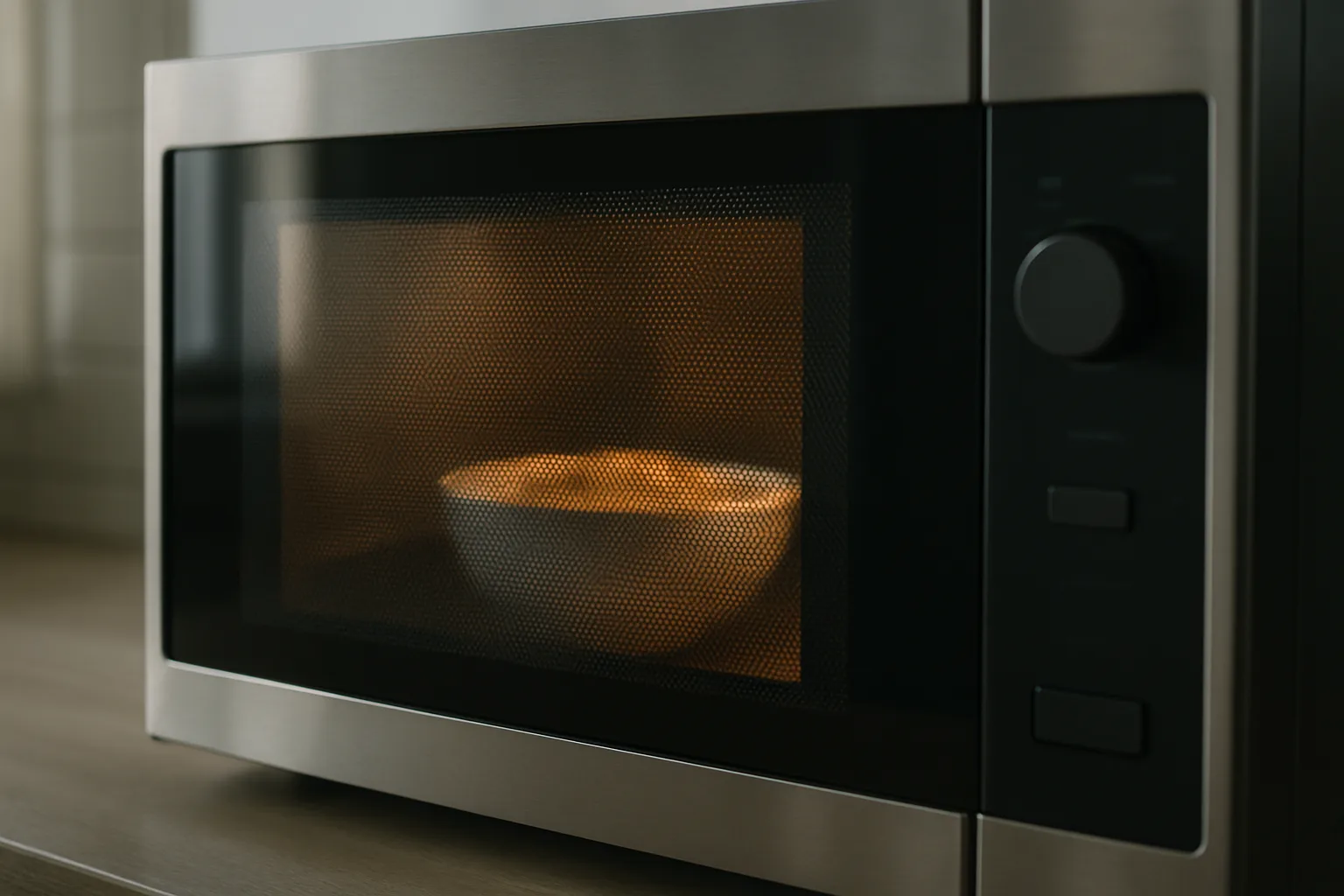
The black mesh in a microwave door is part of its shielding assembly. Its openings let visible light through; colour alone does not identify the exact construction or condition of a particular door.
The small grid with a big job
The dark mesh on a microwave door is a safety screen. Its tiny openings let visible light pass so you can check on your food, while the conductive metal around those openings helps keep the oven’s microwaves inside. In other words, the door is designed to let you see in without giving the cooking energy an easy way out.
It is a clever bit of physics hiding in plain sight. The screen does not need to be a solid sheet of metal: its openings are small compared with the microwaves used for cooking, but large enough for ordinary light to pass through.
Why microwaves stay on one side
A typical domestic microwave oven uses electromagnetic waves at a frequency of about 2.45 gigahertz. In air, a wave at that frequency has a wavelength of roughly 12 centimetres. The holes in the door’s screen are much smaller than that wavelength.
The Canadian Centre for Occupational Health and Safety gives 2450 MHz for most conventional ovens. The roughly 12 cm wavelength is the calculation from frequency and the speed of light in air, not a measurement made on the reader's appliance or a guarantee that a damaged door meets its limit.
The screen is made of conductive material. When microwaves reach it, their electric fields interact with the metal, which reflects and absorbs energy. A closely spaced pattern of small openings makes it difficult for the much longer microwaves to pass through effectively. The result is a barrier that helps contain the energy in the cooking chamber.
Visible light is different in scale. Its wavelengths are hundreds of nanometres—far smaller than the openings in the screen. Light can pass through those openings, which is why you can see the food inside. The mesh is not acting like a special filter that recognises “microwave” radiation; it is taking advantage of the enormous size difference between visible-light waves and cooking microwaves.
This principle is related to a Faraday cage: a conductive enclosure that shields its interior or exterior from certain electric fields and electromagnetic waves. A microwave oven is not simply a box with a screen, though. Its door, frame and other conductive parts are designed together to help contain the oven’s energy.
Why does the mesh look black?
The visible darkness does not identify the screen's exact coating or how that particular door was manufactured. Lighting and the appearance of the surrounding layers also affect what you see. For a named model, its technical documentation is better evidence than the colour alone.
The useful distinction is between appearance and function: an intact conductive screen is part of the door assembly, not a dark paint layer that a reader should remove or modify.
The door is more than a window
The mesh is one part of a carefully designed door. The door and the front of the oven include conductive surfaces and shaped edges that help limit microwave leakage around the opening. Some designs use structures around the door’s perimeter to help contain energy at the seam. The screen, door frame and oven body work as a system.
Microwave ovens also have safety interlocks. These switches are designed to stop the oven from producing microwaves when the door is opened. If the oven continues operating with the door open, stop using it and contact the manufacturer. Do not bypass or tamper with an interlock.
The mesh and interlocks address different parts of the same safety goal: contain the energy during operation, and stop production of that energy if the door is opened. A door that closes properly and is in good condition is important to that design.
What the waves do to food
Inside the oven, microwaves transfer energy to food. Water molecules respond to the changing electric field, and dissolved ions also move in ways that generate heat. That energy warms the food, though it does not always spread evenly. The turntable helps expose different areas to the oven’s field, and letting food stand after cooking can give heat more time to distribute.
As ARPANSA explains, the oven uses non-ionising electromagnetic energy to heat food. It does not make the food radioactive or leave a store of microwaves in it after switching off. Heating can still change food chemically; “non-ionising” should not be read as “cooking cannot cause any chemical change.”
Is it safe to look through the screen?
For an undamaged oven used according to its instructions, yes. The window is there so you can observe the food while the oven is operating. The screen is designed to let visible light through while helping contain the microwave energy, and the complete appliance is built to meet applicable safety requirements when used as intended.
The FDA’s microwave guidance makes safety conditional on the appliance meeting its standard and being used as instructed. Do not operate a microwave with a door that does not close firmly or is bent or damaged; an explanation of the mesh is not a leakage test.
That does not mean a damaged oven should be ignored. Stop using it if the door is bent, will not close securely, has damaged hinges or latches, or has a badly damaged screen or seal. Do not try to repair or defeat the door switches yourself; have the appliance assessed by a qualified service professional or replace it if needed. Keeping the door and its surrounding surfaces clean can also help it close properly.
There is no need to press your face against the door or inspect the mesh for tiny defects during every use. The practical rule is simple: use an oven with an intact door that closes normally, and do not operate one that appears damaged.
A small detail doing serious work
The black grid is easy to mistake for a bit of decoration, but it solves a neat engineering problem. It lets a much shorter kind of electromagnetic wave—visible light—reach your eyes, while the metal pattern helps contain the far longer waves that heat your meal. The mesh is only one layer of the safety design, but it is the part you can see every time you glance at the popcorn.
You might also like
Why Car Windshields Have Black Dots Around the Edges
Those tiny black dots do more than decorate a windshield. They help protect the glass bond, soften the shift from dark to clear, and manage sunlight.

Why Do Mirrors Reverse Left and Right but Not Up and Down?
A mirror does not actually swap left and right. It reverses the direction pointing into the glass—and the way we compare ourselves with the reflection creates the illusion.
Why Does a Retractable Pen Click When You Press It?
A retractable pen’s click comes from a small locking mechanism inside its barrel. Here’s how the button, cam and spring work together to extend and retract the tip.