Why Fire Hydrants Come in Different Colors
By WowPebble Editorial
A hydrant’s color can help firefighters judge water supply, flow capacity, or ownership—but there’s no single color code used everywhere.
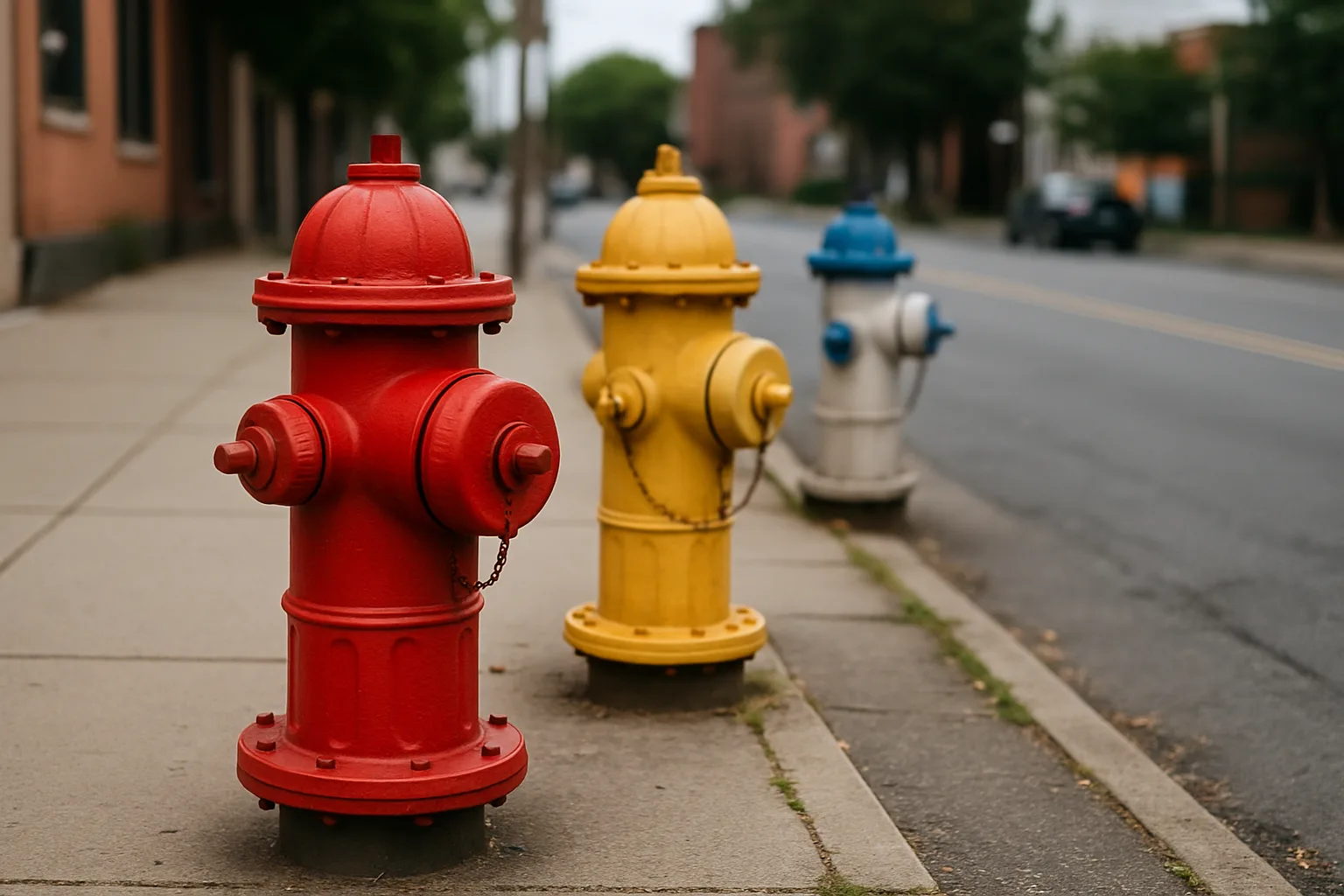
A fire hydrant’s paint can be more than a splash of color on the street. In some places, it gives firefighters a quick clue about how much water the hydrant can supply. In others, colors distinguish public hydrants from private ones or help make them easier to spot. The catch: there is no universal color code, so the same shade can mean different things in different communities.
The color code depends on where you are
Fire hydrants are operated by local water utilities and fire departments, and marking rules can vary by country, state, city, or water system. A color scheme may follow a national recommendation, a local regulation, or a department’s own practice. Even neighboring communities can use different systems.
That means you cannot reliably look at a hydrant anywhere and know its water supply from its paint alone. Fire crews learn the system used in their area and can check local water-supply information. A hydrant’s color is a quick visual aid, not a worldwide label.
Colors can indicate water-flow capacity
A documented US example appears in Mueller’s hydrant-marking white paper, which discusses the 2013 edition of NFPA 291. It describes bonnet/cap classes in US gallons per minute at 20 psi residual pressure. The table below is that identified scheme, not an assertion about the newest edition or every town's rules:
Use the local water/fire authority's adopted specification to identify the relevant parts and testing conditions. A historic recommendation is not proof of today's colour policy or current output of an unfamiliar hydrant.
- Light blue: 1,500 gallons per minute or more
- Green: 1,000 to 1,499 gallons per minute
- Orange: 500 to 999 gallons per minute
- Red: less than 500 gallons per minute
In this system, the color offers a fast indication of whether a hydrant may be a stronger or more limited source of water. A large fire can require substantial water, so knowing a hydrant’s likely capacity helps crews plan where to connect hoses and whether they may need additional supply.
These figures describe a recommendation, not a rule that automatically applies everywhere. Local authorities may adopt the scheme, adjust it, or use a different one. They may also rely on markings on only part of the hydrant, so it matters which components are colored.
Why the flow rate matters
A hydrant connects to a water main, but its output is not determined by the hydrant’s appearance. It depends on factors such as the capacity and pressure of the connected pipes, nearby water use, and the hydrant’s condition. Water departments or fire agencies can test hydrants to estimate the flow available under specified conditions.
A high-capacity hydrant can be especially useful when a fire needs a sustained supply. If a hydrant has lower capacity, firefighters may plan around that limitation, seek another source, or use more than one hydrant. The color makes information easier to see at a glance; it does not replace testing or operational judgment.
The body and the top can have different jobs
The body colour and the bonnet or caps can convey different information. Use the local authority's published scheme to identify which part is coded. The flow table above cannot by itself establish what an unfamiliar body colour means, or the hydrant's present tested output.
The City of Chesapeake’s private-hydrant specification provides a concrete body-colour example: a red barrel for the private hydrants it covers. That local requirement does not mean every red hydrant everywhere is privately owned, or that body red has the same meaning as a red flow-coded cap.
Visibility is part of the reason, too
A hydrant needs to be easy to find, including at night, in poor weather, or among parked cars and street clutter. Bright paint can make a hydrant stand out from its surroundings. Some communities use reflective markings or add nearby signs and markers, especially where snow might cover the hydrant itself.
Visibility and information can work together: a vivid color helps crews locate the equipment, while a color scheme may help them interpret its capacity or ownership. But one goal can take priority over another. A community might choose a body color that is easy to see and use a different marking system to convey technical details.
Hydrants are marked differently around the world
Suffolk Fire and Rescue describes underground hydrants located by yellow marker posts. The markers identify location and water-main information rather than using a US-style painted-post scheme. Other authorities can use different signs and equipment.
This variety reflects differences in local water networks and firefighting practices. It also explains why photographs of hydrants from different cities can show strikingly different colors without any of them necessarily being wrong.
What a hydrant’s color cannot tell you
Paint is useful, but it is not a guarantee of current performance. A hydrant could have been repainted, its markings may have faded, or local conventions may have changed. And even a color scheme designed to indicate flow describes tested conditions—not necessarily the exact supply available at every moment.
For firefighters, the safest guide is the information maintained by local water and fire authorities, along with current conditions and testing. For everyone else, the simple takeaway is that hydrant colors are practical clues shaped by local rules. They can communicate important information, but there is no single color key that works on every street.
You might also like
Why Traffic Lights Use Red, Yellow, and Green
Red, yellow, and green were chosen for a mix of history, visibility, and practicality. Here’s how the familiar traffic signal system took shape.

Why Do Mirrors Reverse Left and Right but Not Up and Down?
A mirror does not actually swap left and right. It reverses the direction pointing into the glass—and the way we compare ourselves with the reflection creates the illusion.
Why Does a Retractable Pen Click When You Press It?
A retractable pen’s click comes from a small locking mechanism inside its barrel. Here’s how the button, cam and spring work together to extend and retract the tip.