What Do the Symbols on Clothing Care Labels Mean?
By WowPebble Editorial
Decode the little symbols on clothing labels, from wash temperatures to drying and ironing instructions, and learn how to use them to care for your clothes.
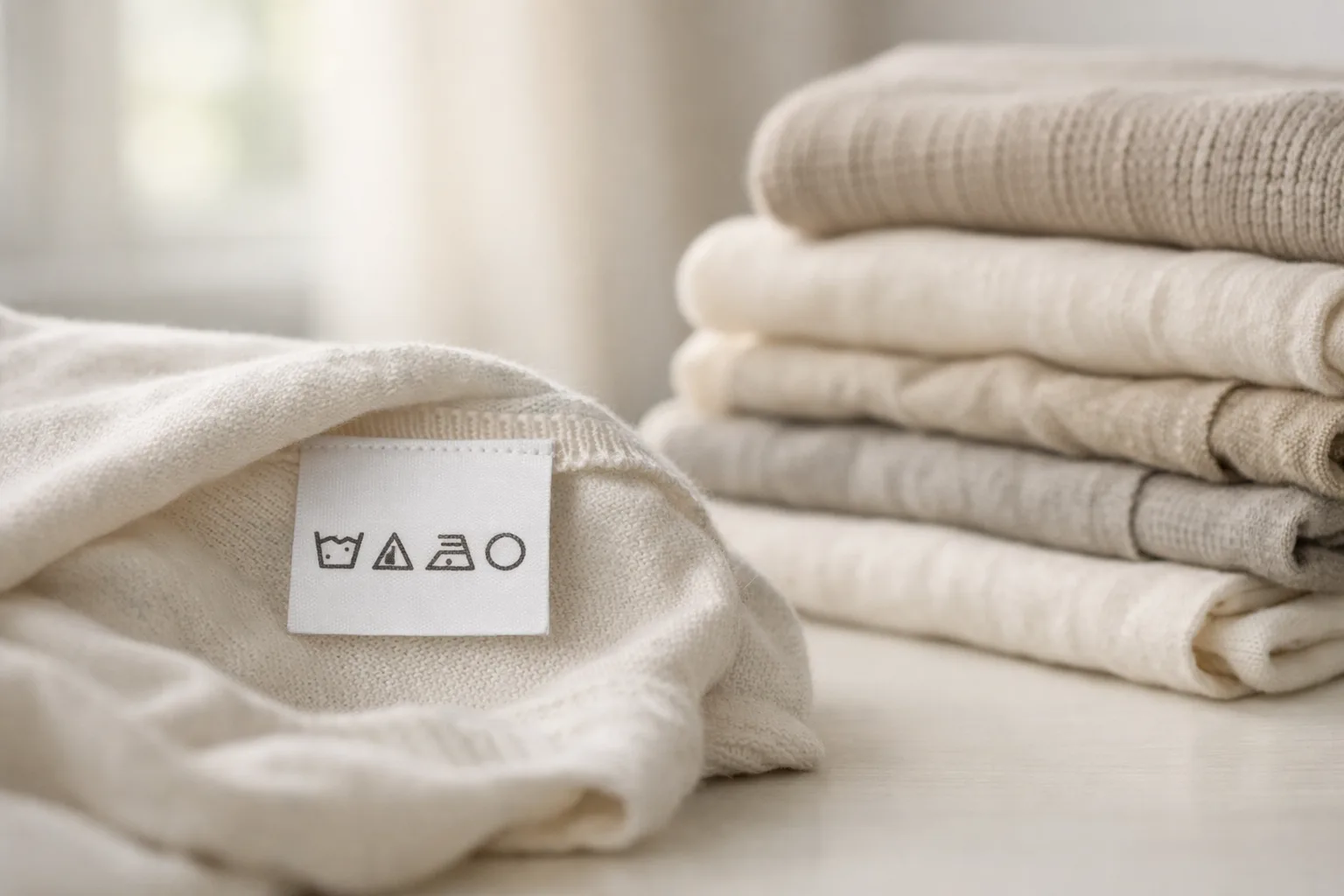
A tiny square, a crossed-out triangle, a basin with a number: clothing care labels can look like a code. The good news is that the symbols follow a simple system. Each shape points to a type of care—washing, bleaching, drying, ironing or professional cleaning—while numbers, dots, lines and crosses add instructions. Once you know the key, you can read a label at a glance and avoid treatments a garment may not tolerate.
The descriptions below follow the linked GINETEX textile-care guide, whose symbols underpin ISO 3758. Other national label systems and editions can differ. Read this as one identified key, not a chart that merges every regional variant. Symbols indicate maximum permitted treatment, not a promise that a stain will be removed.
The five basic symbols
Most care labels use five main shapes, often arranged in this order:
- A washtub means washing.
- A triangle means bleaching.
- A square means drying.
- An iron means ironing.
- A circle means professional cleaning.
A cross over a symbol usually means “do not” perform that treatment. Dots often indicate temperature or heat, while lines underneath a symbol usually mean the process should be gentler.
The washtub: washing
The washtub tells you whether and how to wash a garment. A number inside it indicates the maximum wash temperature, generally in degrees Celsius. For example, a tub marked 30 means wash at no more than 30°C. It does not mean you must use exactly that temperature: a cooler wash may be suitable, depending on the item and the detergent.
A hand inside the tub means hand wash. Use water and gentle movement rather than putting the item through an ordinary machine cycle. A tub with a cross means do not wash; check whether the label gives professional-cleaning instructions instead.
In the GINETEX system, bars below the washing tub indicate a milder process: one bar and two bars are different restrictions. Their printed length is not a separate severity scale. Use the full symbol and the label's instructions; a machine's marketing name for a programme does not by itself establish equivalence.
Some systems use dots rather than numbers to show washing temperature. In those cases, more dots mean a higher temperature. Always read the symbols in the context of the label system used on the garment.
The triangle: bleaching
A plain triangle means bleaching is allowed, if needed. A triangle crossed out means do not bleach. A triangle with two diagonal lines generally indicates that only non-chlorine bleach should be used. This type of bleach is often called oxygen bleach or color-safe bleach, but check the product instructions before using it.
Bleach can affect dyes and fibers, so permission to use it does not mean it is necessary. If you are unsure how a colored item will react, follow the garment’s instructions and test any suitable product on an inconspicuous area, if the product directions allow.
The square: drying
The square covers drying. For GINETEX tumble-drying symbols, the circle inside the square uses two dots for a normal process and one for a reduced-temperature process; a crossed-out tumble-drying symbol prohibits it. Do not add a third-dot rule to that key. Other labelling systems can use different variants, so identify the system rather than combining charts from different regions.
Other marks inside the square describe air-drying methods. A horizontal line means dry flat; a vertical line means hang to dry. Additional marks can indicate drip drying or drying in the shade. These details matter for garments that may stretch, lose their shape or fade with strong heat or sunlight. If a label says to dry flat, lay the item on a clean surface rather than hanging it while wet.
The iron: ironing
The iron symbol tells you whether ironing is suitable and how much heat to use. One dot means low heat, two dots medium heat and three dots high heat. A crossed-out iron means do not iron.
Some iron symbols show crossed-out steam beneath or beside the iron. That means do not use steam. If the label allows ironing but you are unsure of the setting, begin with a low temperature and increase it only if necessary. A pressing cloth can also help protect delicate or textured fabric, provided the garment’s care instructions allow ironing.
The circle: professional cleaning
A circle signals that a garment may need professional cleaning. Letters inside it—commonly P or F—give the cleaner information about the cleaning process or solvents to use. They are mainly instructions for professionals, rather than a home-cleaning recipe. A circle with a W refers to professional wet cleaning, a specialized process that uses water under controlled conditions.
A crossed-out ordinary circle in the GINETEX professional-care key means do not dry clean. Professional wet cleaning has its own W symbol and restrictions; the dry-cleaning prohibition does not automatically settle that separate treatment. Give an unclear label to the cleaner rather than substituting a home solvent recipe.
How to read a label in practice
Imagine a label showing a washtub marked 30 with one line beneath it, a crossed-out triangle, a square with a circle and one dot, and an iron with two dots. Read it in order: wash at no more than 30°C on a gentle cycle; do not bleach; tumble dry on low heat; and iron on medium heat. If there is also a circle, check its letter or mark for professional-cleaning guidance.
It helps to treat the strictest instruction as the one to follow. A low wash temperature cannot make bleaching safe if the triangle is crossed out, and a permitted tumble-dry setting does not cancel a separate “dry flat” instruction. When symbols seem to conflict, look for written notes, consider the fabric and construction, and choose the least aggressive care method that still gets the garment clean.
Why labels are worth checking
Different fibers and finishes respond differently to water, heat, friction and cleaning products. A sturdy cotton shirt may cope with a routine wash, while a lined jacket or a delicate knit can be damaged by the same treatment. Care symbols turn those risks into compact instructions that can travel with the garment, even when the person doing the laundry does not know how it was made.
The label does not make every machine programme or cleaning product equivalent. Follow the specified process and the detergent directions, and account for trims, coatings and construction as well as fibre names. If the label is missing or contradictory, ask the maker or a qualified cleaner; cool water is not automatically harmless to an unidentified garment.
You might also like

Why Do Mirrors Reverse Left and Right but Not Up and Down?
A mirror does not actually swap left and right. It reverses the direction pointing into the glass—and the way we compare ourselves with the reflection creates the illusion.
Why Does a Retractable Pen Click When You Press It?
A retractable pen’s click comes from a small locking mechanism inside its barrel. Here’s how the button, cam and spring work together to extend and retract the tip.

Why Do Chimneys Have Caps? The Practical Reasons Explained
Chimney caps keep out rain, animals and debris, and some help contain sparks or reduce wind-driven downdrafts. Here’s how they work—and what they don’t do.