What Is the Drawer Beneath an Oven Designed to Do?
By WowPebble Editorial
That oven drawer may be for storing pans, keeping food warm, or broiling. Its purpose depends on the range—and using it the wrong way can be risky.
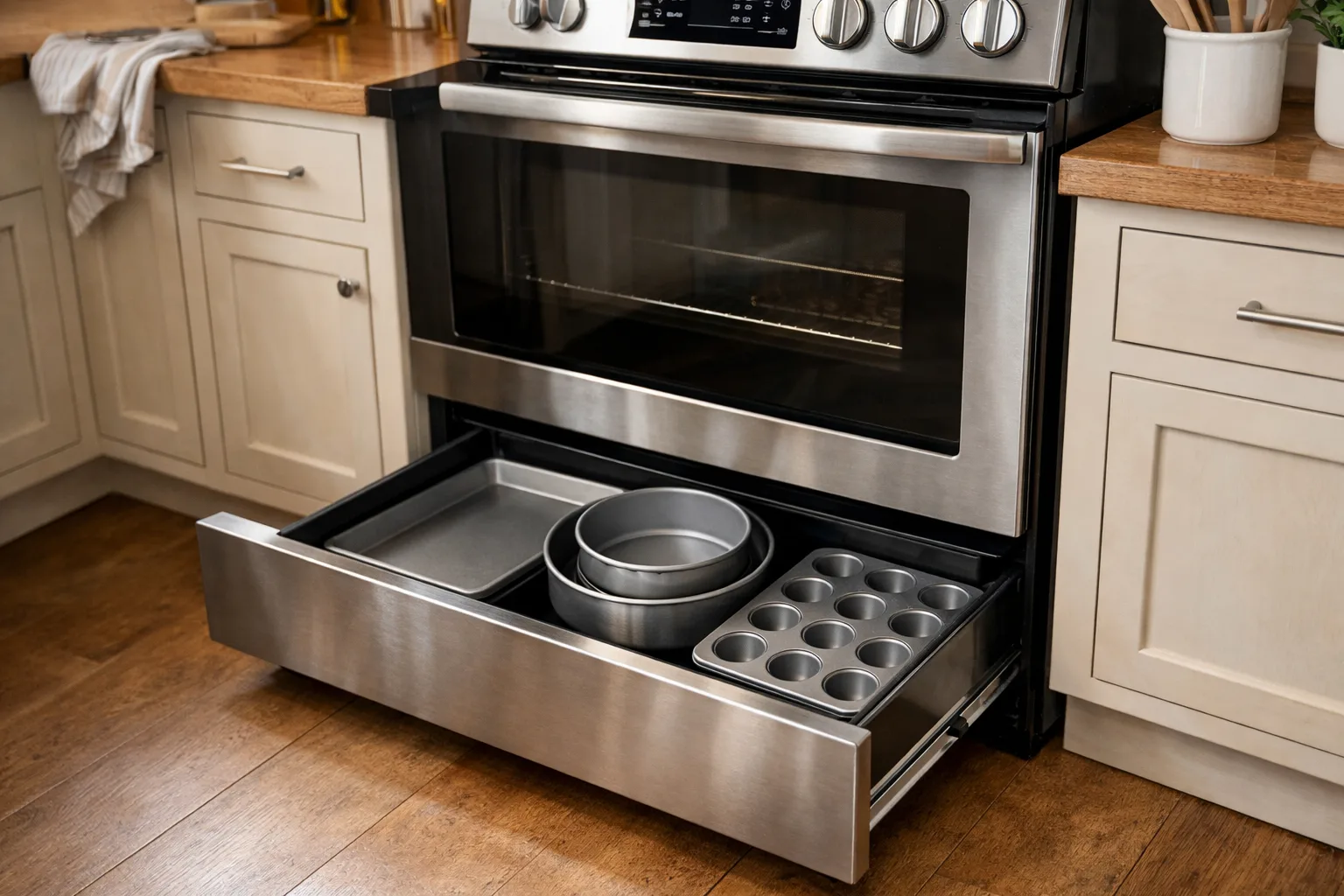
The drawer beneath an oven looks like a simple place to stash baking sheets, but that is not always what it is for. Depending on the range, it may be a storage drawer, a warming drawer, or a broiler compartment. Those functions are not interchangeable: putting cookware in a broiler drawer, for example, could expose it to intense heat.
The short answer is that there is no single purpose shared by every oven drawer. The design and controls on your particular range are the best clues, and the owner's manual can confirm what the drawer is meant to do.
Three common kinds of oven drawer
A storage drawer is intended for cookware and other oven-safe items, often baking pans. It usually has no separate temperature control. Even so, the drawer can become warm while the oven is on, because heat from the appliance may reach the space below it. That means it is not automatically a safe spot for anything that can melt, scorch, or catch fire.
A warming drawer is designed to hold cooked food at a warm temperature before serving. It typically has its own control, which may offer settings such as low, medium, or high. Some warming drawers can also help warm plates or bread, but the manual will explain which uses are appropriate. They are not intended to cook raw food or replace an oven.
A broiler drawer is a cooking compartment. On some ranges, a burner or heating element sits inside the drawer, allowing food to cook under direct, intense heat. Broiling can brown or char the surface quickly, so it requires more attention than simply storing a pan. The rack position, pan type, and operating instructions vary by model.
How to tell which one you have
Start with the controls. A separate dial or button labeled for warming is a strong clue that the drawer is a warming drawer. A broil setting on the main oven control does not, by itself, prove that the drawer is a broiler; on many ranges, broiling happens inside the main oven.
Next, look for labels, diagrams, or instructions on the appliance. Some ranges have a warning or use label near the drawer, while others show the drawer's function in the manual. If you cannot find the booklet, search for the model number, usually printed on a label around the oven door frame, behind the drawer, or elsewhere specified by the manufacturer. The model number can help you find the correct instructions online.
You can also inspect the drawer when the range is cool. A broiler compartment may have a rack or broiler pan and a layout that places food close to a heat source. A warming drawer may have its own controls and a smooth interior intended to hold dishes or food. But appearance alone is not definitive: ranges vary, and accessories may be missing. When in doubt, check the manual rather than testing the drawer with food or cookware.
If it is a storage drawer
A storage drawer is useful for keeping suitable ovenware close at hand. Before putting items in it, check the manual for any storage restrictions. Avoid treating it as a general-purpose cupboard for plastic containers, paper, dish towels, or other items that could be damaged by heat. Even when the oven is not set to a high temperature, the area can warm during use, and the amount of heat depends on the appliance.
Be careful when opening the drawer after cooking. Stored pans may be hot, and warm air can escape. Let items cool before handling them, and avoid packing the drawer so tightly that it is difficult to open or close. The drawer is for storage, not an extension of the oven cavity; it should not be used to bake or cook unless the manufacturer specifically says it is designed for that purpose.
If it is a warming drawer
A warming drawer helps bridge the gap between cooking and serving. It can keep prepared food warm for a short period while other parts of a meal finish, or warm serving dishes if the instructions allow. Use the temperature setting and time guidance recommended for your model. Food safety depends on how food is handled and held, so do not assume that any setting will keep every dish safe indefinitely.
Follow the manufacturer's advice about covering food, arranging dishes, and using the drawer's racks. Some foods can dry out if left uncovered, while certain materials may not be suitable for warming. Avoid using a warming drawer to reheat food unless the manual specifically permits it; reheating and keeping food warm are different jobs.
If it is a broiler drawer
Treat a broiler drawer as a high-heat cooking appliance, not as storage. Use only the pans and rack positions recommended in the manual, and keep the drawer clear of anything that does not belong there. Because broiling can brown food quickly, stay nearby and monitor it rather than relying on a timer alone.
Take care when opening the drawer: hot air and surfaces can cause burns. Use oven mitts, keep children away, and follow the appliance's directions for preheating and ventilation. Do not improvise with cookware that may be unsuitable for direct heat. If the drawer's purpose or operation is unclear, do not try broiling until you have identified the model and read its instructions.
Why the drawer can be confusing
Ranges can look very similar while having different features. A drawer that seems to be a convenient place for pans on one model may be a broiler compartment on another. Warming drawers are also easy to mistake for ordinary storage drawers if their controls are subtle or unfamiliar. In addition, heat from the oven can make a storage drawer feel warm, which may lead people to assume it has a special heating function.
The safest rule is simple: identify the drawer before using it. Check the labels and controls, then confirm the answer in the manual for your exact model. Once you know whether it is for storage, warming, or broiling, the drawer becomes a useful part of the range rather than a mystery hiding beneath the oven.
You might also like
What Your Refrigerator’s Crisper Drawer Is Actually Designed to Do
That special drawer in your fridge is more than a produce bin. Here’s how its humidity control works—and how to use it to help fruits and vegetables last.
Why Do Mirrors Reverse Left and Right but Not Up and Down?
A mirror does not actually swap left and right. It reverses the direction pointing into the glass—and the way we compare ourselves with the reflection creates the illusion.
Why Does a Retractable Pen Click When You Press It?
A retractable pen’s click comes from a small locking mechanism inside its barrel. Here’s how the button, cam and spring work together to extend and retract the tip.